
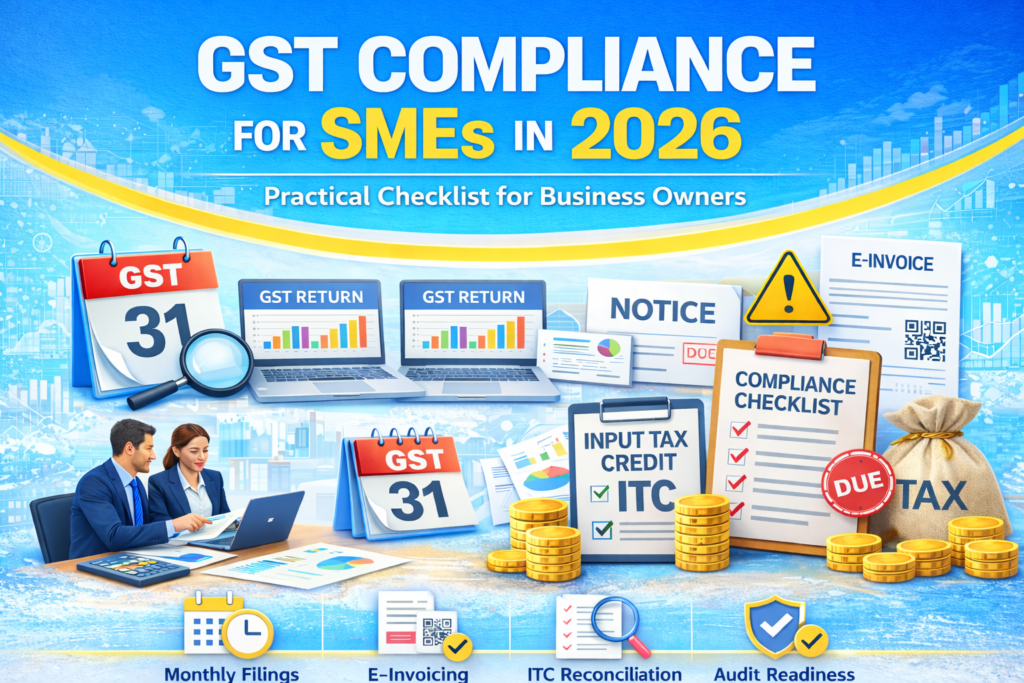
If you ask growing business owners what keeps them awake at night, GST is rarely the first answer.
Sales targets, hiring, competition, those usually take priority.
And yet, when something goes wrong with GST, the impact is immediate. Input tax credit gets blocked. Cash flow tightens. Notices arrive. Vendors start asking questions. Suddenly, something that seemed administrative becomes urgent.
In 2026, GST compliance is less about filing forms and more about maintaining control. The system is automated, tightly monitored, and far less forgiving than it used to be. For small and medium businesses, this means discipline matters.
This guide is not a legal explanation of GST. It is a practical GST compliance checklist designed for business owners and startup founders who want clarity, and fewer surprises.
Why GST Compliance Feels More Sensitive in 2026
Over the years, the GST framework has become deeply data-driven. Returns are cross-matched. E-invoices sync automatically. ITC claims are validated against supplier filings. Discrepancies don’t remain invisible for long.
What used to be caught during assessment years later is now flagged within months.
For SMEs, the most visible risk is input tax credit. If your vendor does not file correctly, your credit may not reflect in GSTR-2B. If your outward supplies don’t align with your tax payments, the system detects it.
The point is not to create anxiety. The point is to recognise that GST requirements in India have evolved. Compliance now demands routine structure.
1. Begin With Your GST Registration
It sounds basic, but registration accuracy is often overlooked.
Businesses expand, shift offices, add partners, change operations — and GST registration remains unchanged for years.
Take time to review:
- Is your registration under the correct scheme, Regular or Composition?
- Has your principal place of business changed?
- Are additional business locations declared?
- Have director or partner updates been filed?
- Are HSN or SAC codes aligned with what you actually supply?
- Is your bank information current?
These details may seem minor, but during scrutiny or departmental review, inconsistencies create avoidable complications.
Registration should be reviewed periodically, not only at the time of setup.
2. Monthly Return Filing: Where Most Problems Begin
For many businesses, GST filing happens close to the deadline. Numbers are extracted, summaries prepared, returns uploaded.
That approach works, until it doesn’t.
GSTR-1: Reporting Sales
Before filing GSTR-1, pause and reconcile.
Are invoice numbers sequential?
Do sales figures match your accounting system?
Are B2B GSTINs correct?
Have credit notes been reported accurately?
Errors here don’t just affect you. They affect your customers’ ability to claim input tax credit. Over time, that impacts credibility.
GSTR-3B: Summary and Payment
GSTR-3B should never be treated as an estimated return.
Before submission:
- Match turnover with GSTR-1.
- Compare ITC with GSTR-2B.
- Review tax liability carefully.
- Ensure correct utilisation of ITC.
- Confirm sufficient balance in cash ledger.
Mismatch between GSTR-1 and GSTR-3B remains one of the most common triggers for notices. A 30-minute reconciliation review can prevent months of follow-up.
3. Input Tax Credit: Protecting Working Capital
For small and medium businesses, ITC is not a technical entry. It directly impacts cash flow.
Under present GST requirements in India, ITC is available only when conditions are satisfied:
- Supplier has filed returns.
- Invoice appears in GSTR-2B.
- Tax has been paid by supplier.
- Goods or services are received.
This means your compliance depends partly on vendor discipline.
A practical monthly process should include:
- Downloading GSTR-2B.
- Matching it with the purchase register.
- Identifying missing invoices.
- Following up with vendors.
- Reversing ineligible credits promptly.
Overclaiming ITC may temporarily improve numbers, but it increases risk. Conservative, well-documented claims protect stability.
4. E-Invoicing and E-Way Bill Control
If your turnover crosses notified thresholds, e-invoicing becomes mandatory.
Ensure:
- IRN is generated before issuing an invoice.
- QR code prints correctly.
- Invoice data matches return data.
For e-way bills, errors are operationally expensive. Incorrect vehicle numbers or expired validity can lead to goods detention.
Compliance here is not about tax, it is about uninterrupted business movement.
5. GST Payments and Interest Exposure
Late payment, even by small amounts, attracts interest.
Many businesses assume filing on time is sufficient. It is not. Tax must also be paid accurately and fully.
Each month, review:
- Electronic liability ledger.
- ITC utilisation.
- Cash ledger balance.
- Interest on delayed payments.
Small unpaid balances across months accumulate quietly. Periodic review prevents unpleasant surprises.
6. QRMP and Quarterly Obligations
If your business is under the QRMP scheme, remember that quarterly filing does not eliminate monthly responsibility.
Monthly tax payments must be made on time. Sales tracking must remain accurate. ITC reconciliation should not wait for quarter-end.
Discipline remains essential.
7. Annual Return: A Mirror of the Year
When preparing GSTR-9, many businesses realise errors made earlier.
Turnover mismatches. ITC differences. Classification errors.
To avoid year-end stress:
- Reconcile turnover with financial statements.
- Review ITC claims for the year.
- Validate tax payments.
- Ensure amendments are correctly reported.
If monthly processes are stable, annual return becomes a confirmation exercise rather than a correction project.
8. Where SMEs Commonly Slip
Across growing businesses, similar patterns appear:
Filing without reconciliation.
Claiming ITC without checking GSTR-2B.
Ignoring GST portal notices.
Improper HSN classification.
Weak documentation retention.
These are not complex errors. They are procedural gaps.
A structured GST compliance checklist eliminates most of them.
9. When Should You Consider Professional Support?
Many founders initially manage GST internally. That works at smaller scale.
However, as transaction volumes grow, multi-state operations begin, or investors demand clean records, complexity increases.
Professional GST Return Filing Services become valuable when:
- Turnover scales rapidly.
- ITC reconciliation becomes time-consuming.
- Notices are received.
- Internal staff lacks technical depth.
- You prefer focusing on growth instead of compliance follow-ups.
Reliable GST compliance services in India do more than file returns. They introduce structure, review reconciliations, monitor risks, and ensure documentation remains audit-ready.
For growing businesses, that shift reduces uncertainty.
A Practical GST Compliance Checklist for 2026
Use this as a working reference:
- GST registration details reviewed.
- Monthly GSTR-1 reconciled before filing.
- GSTR-3B aligned with books and GSTR-2B.
- ITC monitored every month.
- Vendor compliance tracked.
- E-invoicing rules followed (if applicable).
- E-way bills accurate.
- Tax payments verified before submission.
- Interest exposure reviewed.
- Annual return reconciled with financial statements.
- Notices responded promptly.
- Documentation maintained systematically.
If you can confidently confirm each point, your compliance foundation is stable.
Conclusion
GST compliance is rarely about complexity. It is about consistency.
Businesses that approach GST with monthly structure experience fewer disruptions. Those that treat it as a deadline-driven activity often find themselves reacting to notices instead of focusing on growth.
In 2026, compliance discipline is part of operational maturity.
It protects working capital. It strengthens vendor relationships. It reduces audit anxiety.
Most importantly, it allows business owners to focus on building their company instead of correcting past filings.
Frequently Asked Questions on GST Compliance for SMEs in 2026
- Why is GST compliance more sensitive for SMEs in 2026?
GST systems are now automated and data-driven, with returns cross-matched in real time. Even small mismatches in ITC or turnover can trigger notices quickly. - How often should businesses reconcile GSTR-1 and GSTR-3B?
Reconciliation should be done every month before filing returns. Matching sales, tax liability, and ITC with GSTR-2B prevents costly discrepancies. - What is the biggest GST risk for growing businesses?
Incorrect or excess Input Tax Credit claims are the most common issue. ITC must match GSTR-2B and supplier filings to avoid reversals and penalties. - Is filing GST returns on time enough to stay compliant?
No. Timely filing must be accompanied by accurate tax payment and proper reconciliation. Even minor unpaid balances can attract interest. - When should an SME consider professional GST support?
When turnover increases, multi-state operations begin, or notices are received. Professional review ensures reconciliations, documentation, and compliance remain audit-ready.