
For most foreign founders, the first assumption is that company formation in India must be slow.
It sounds like the kind of process that would take months. Government filings. Cross-border paperwork. Certifications. Approvals.
In reality, it usually does not take that long.
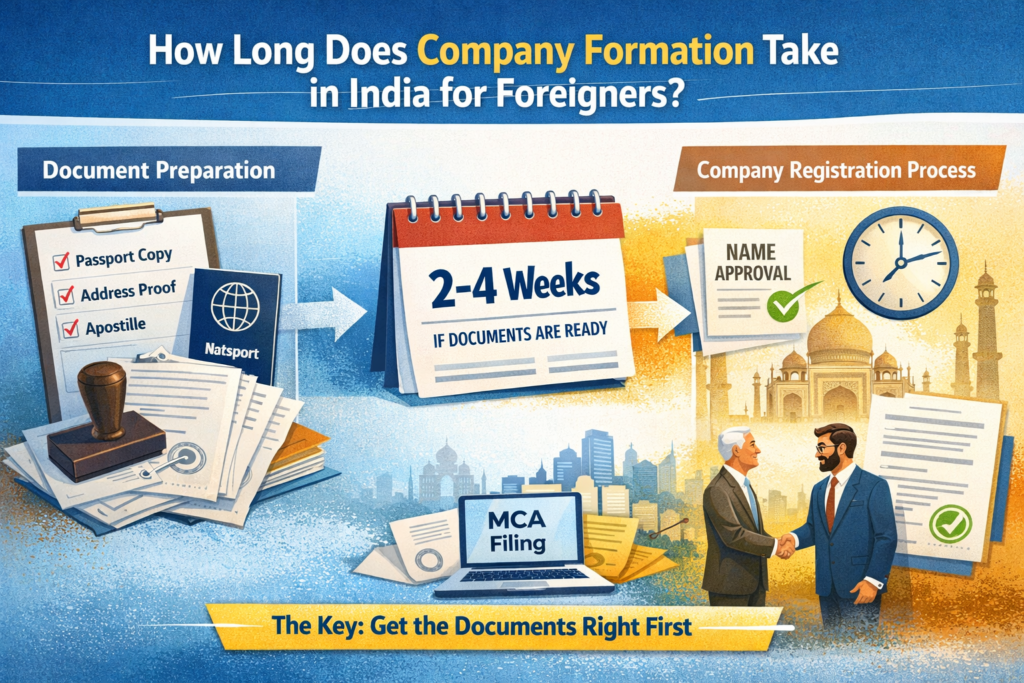
If the documents are ready and there are no mistakes in the filing, a foreign national can often complete the company incorporation process in roughly two to four weeks. Sometimes faster. Sometimes a little slower. The range exists for one simple reason: the paperwork matters more than people expect.
That is usually where the delay begins.
The process is not the problem. The documents usually are.
When people talk about timelines, they often focus on the filing itself. But that is not where most foreign applicants lose time.
The real hold-up is usually earlier.
A passport copy has not been notarised properly. The address proof is older than it should be. An apostille is missing. The proposed company name gets rejected. None of these issues are dramatic on their own. But together, they stretch the timeline.
So when someone asks how long incorporation takes, the honest answer is this: the filing can move quite quickly, but only after the documents are in order.
It usually starts with document readiness
Before anything is submitted in India, the foreign director’s documents need to be prepared.
That part sounds simple. It often isn’t.
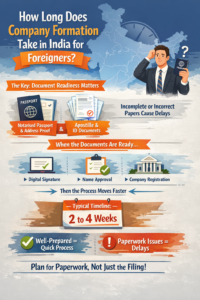
A foreign national will generally need a passport copy, address proof, and supporting identification documents in the format required for Indian filings. In many cases, these documents must be notarised in the home country. Depending on the jurisdiction, apostille requirements may also apply.
This is where the timeline becomes unpredictable. Not because India is slow, but because document authentication in another country may take a few days or more, depending on local process and availability.
And if one document is not acceptable, the clock starts slipping before the incorporation application is even filed.
Once the papers are ready, things move faster
After that, the process tends to become more structured.
The digital signature for the proposed director is usually one of the early steps. That is necessary because company filings in India are done electronically. Then comes the name application, followed by the incorporation filing with the Ministry of Corporate Affairs.
If everything is clean, these stages do not usually drag.
In fact, many foreign founders are surprised by this. They expect the Indian side of the process to be the slow part. Quite often, it is the opposite. Once the filing starts properly, the system is relatively straightforward.
Name approval can save time or waste it
This part is often underestimated.
A founder may have a preferred company name already in mind, but that does not mean it will be approved. If it is too close to an existing name, too generic, or conflicts with an existing trademark, it may come back for revision.
That adds time.
Not a huge amount, necessarily. But enough to matter when someone is trying to launch quickly, open a bank account, sign customers, or close an investment-linked compliance requirement.
A name that works commercially does not always work legally. That distinction catches people off guard.
So what is a realistic timeline?
If you are looking for a practical answer, not a brochure answer, think in terms of two to four weeks.
That is a fair planning window for many foreign nationals setting up a company in India.
It can move quicker when the documents are already notarised, the name is available, and the filing is done correctly the first time. It can take longer when documents need to be redone or the structure is not clear from the beginning.
That is why two people can go through the same incorporation route and come away with completely different views of the process. One says it was smooth. The other says it took forever.
Usually, both are telling the truth.
Why many foreign founders use professional help
This is also the reason many businesses use advisors for company formation services in India.
Not because incorporation is impossible to understand. It is not.
But when someone handles these filings regularly, they can spot problems before submission. A mismatch in the passport copy. An address proof that will likely be rejected. A name that looks risky. Those are small issues, but they are the ones that quietly stretch timelines.
For a foreign founder, especially someone doing this from outside India, that review layer can make the difference between a smooth process and a frustrating one.
The simplest way to think about it
If the documents are ready, company formation in India is usually a matter of weeks, not months.
That is the real takeaway.
The process has become far more structured than many people assume. What slows it down is rarely the incorporation framework itself. It is usually incomplete paperwork, document authentication gaps, or filing errors that could have been avoided earlier.
So if you are planning ahead, focus less on the filing date and more on document readiness.
That is what usually decides the timeline.
Frequently Asked Questions on Company Formation in India for Foreigners
1. How long does it take to register a company in India for foreign nationals?
Typically, company registration in India takes around 2 to 4 weeks, depending on document readiness and approval timelines.
2. What documents are required for foreign company formation in India?
Foreign directors usually need a notarised passport, valid address proof, and in some cases, apostilled documents as per Indian compliance requirements.
3. Why do delays happen in company incorporation for foreigners?
Most delays occur due to incorrect or incomplete documents, missing notarisation or apostille, or issues during name approval.
4. Is physical presence required for foreign founders to register a company in India?
No, the entire company incorporation process can be completed online without the need for the foreign director to be physically present in India.
5. Can a company name be rejected during registration in India?
Yes, if the proposed name is too similar to an existing company, trademarked, or does not meet MCA guidelines, it may be rejected.
6. Do foreign founders need professional help for company formation in India?
While not mandatory, professional assistance helps avoid errors, speeds up approvals, and ensures compliance with Indian regulations.