
CODE ON SOCIAL SECURITY, 2020
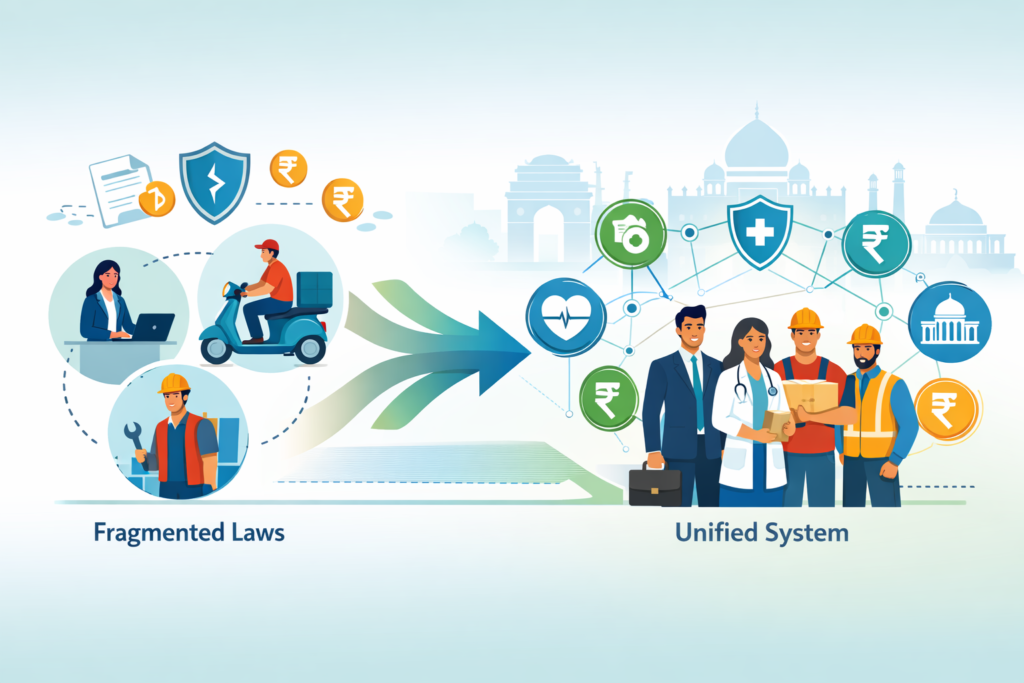
The Code on Social Security, 2020 marks a significant step in India’s labour law reforms, consolidating multiple social security laws into a unified framework. As part of recent legal updates, the Code expands coverage to all workers, including those in the unorganized, gig, and platform sectors.
- The Employees’ Provident Funds and Miscellaneous Provisions Act, 1952
- The Employees’ State Insurance Act, 1948
- The Payment of Gratuity Act, 1972
- The Maternity Benefit Act, 1961
- The Employees’ Compensation Act, 1923
- The Employment Exchanges (Compulsory Notification of Vacancies) Act, 1959
- The Cine Workers Welfare Fund Act, 1981
- The Building and Other Construction Workers Welfare Cess Act, 1996
- The Unorganized Workers’ Social Security Act, 2008
The Code applies to establishments and workers across organized, unorganized, and emerging sectors, thereby significantly widening the scope of social protection in India.
Key Highlights
Expansion of Social Security Coverage
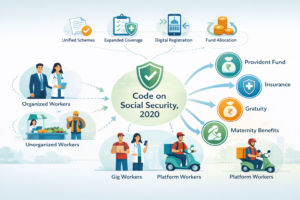
The Code extends social security benefits to unorganized workers, gig workers, and platform workers, who were previously outside the ambit of traditional labor laws. It enables the Central and State Governments to formulate welfare schemes relating to life and disability cover, health benefits, old age protection, and other welfare measures.
Provident Fund Provisions
The Code retains the applicability of provident fund benefits to establishments employing 20 or more employees. Both employer and employee contributions continue, ensuring long-term financial security post-retirement.
Employees’ State Insurance Expansion
The Code expands ESI coverage beyond factories to all establishments employing 10 or more persons, with provisions for voluntary coverage of smaller establishments. It also enables extension of ESI benefits to unorganized workers, subject to government schemes.
Gratuity for Fixed-Term Employees
A significant reform under the Code is the provision of pro-rata gratuity for fixed-term employees, even if they do not complete five years of continuous service. This ensures equitable treatment and benefits for contractual workforce.
Maternity Benefits
The Code retains and strengthens provisions relating to maternity benefits, ensuring:
- Paid maternity leave
- Protection against dismissal during maternity
- Additional benefits as prescribed
Social Security for Gig & Platform Workers
For the first time, the Code formally recognizes gig workers and platform workers and mandates the formulation of dedicated social security schemes. Funding may include contributions from aggregators, government support and other prescribed sources
Registration of Workers
The Code provides for mandatory registration of unorganized, gig, and platform workers through a centralized or state-based system, enabling better identification and delivery of benefits.
Establishment of Social Security Funds
The Code enables the creation of Social Security Funds at Central and State levels for the welfare of unorganized workers, ensuring structured financial support for welfare schemes.
Why It Matters
- Expands the scope of social security to include previously excluded workforce segments such as gig and platform workers.
- Simplifies and consolidates nine labour laws into a single, unified Code.
- Enhances financial and health security for workers across sectors.
- Introduces flexibility for the government to extend benefits to emerging forms of employment.
- Strengthens compliance through digitization and streamlined processes.
Conclusion
The Code on Social Security, 2020 strengthens and broadens India’s social protection framework by extending benefits to a wider workforce, including unorganized and gig workers. It simplifies compliance while ensuring greater financial and social security, making it essential for employers to align their policies with the new regulatory regime.