
A practical guide from Atms Advisors, for founders who’d rather be running their business than chasing filing deadlines.
You started your business to solve a problem, build something, or serve people better than anyone else in your space.
You did not start it to become an expert in GST reconciliation.
And yet, here you are, somewhere between managing your team, closing sales, and handling operations, also trying to figure out whether your GSTR-3B is correct, whether you should have deducted TDS on that last consultant payment, and whether your company’s ROC filings are actually up to date.
At Atms Advisors, we work with SME founders every day. And the most common thing we hear is not “I don’t care about compliance.” It is “I don’t know what I should be handling myself and what I should be handing off.”
This blog answers exactly that.
What compliance does an SME actually need to manage?
Before deciding what to outsource, it helps to know what is on the table. Here is what most small and medium businesses in India are responsible for:
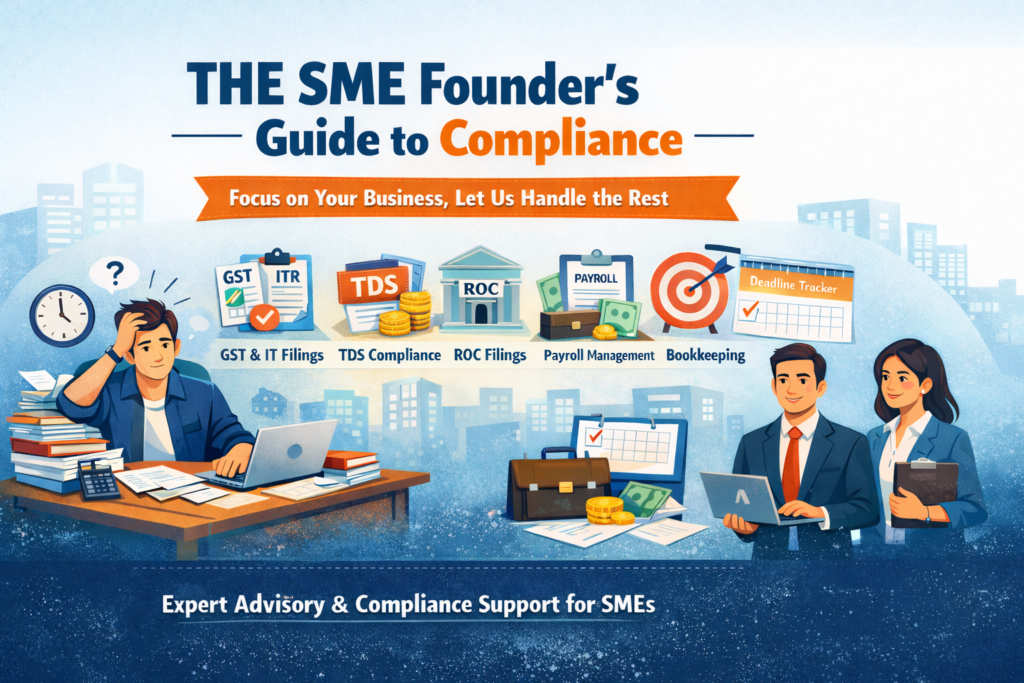
GST : Monthly and annual return filing, input tax credit reconciliation, e-invoicing if applicable.
Income Tax : Advance tax deposits through the year, ITR filing, tax planning to legally reduce your liability.
TDS : Deducting tax at source on vendor payments, rent, salaries, and professional fees, then depositing and filing quarterly returns.
Payroll: Salary processing, PF and ESI contributions, issuing Form 16 to employees.
ROC Filings : Annual compliance for private limited companies, including financial statements and annual return with the Ministry of Corporate Affairs.
Bookkeeping : Maintaining clean, accurate financial records that make everything else possible.
Each of these runs on a deadline. Each has a penalty structure for errors or delays. And each requires a different level of expertise to get right.
Should I handle GST filing in-house?
This is the question we get most often, and the honest answer is: only if you have a trained, dedicated person doing it consistently.
GST filing is not complicated when everything is clean. But clean is rare. Interstate transactions, multiple product categories, vendors who file late, amendments from previous months, each of these adds a layer that requires experience to handle correctly.
The bigger risk is ITC mismatch. If your input tax credit claims do not match what your suppliers have filed, you are exposed to a demand notice. The system catches this automatically now, and notices have gone up significantly as GST data matching has improved.
What to hand off to your CA or advisory firm: GSTR-1, GSTR-3B, annual return preparation and filing, ITC reconciliation.
What to manage in-house: Keeping your sales invoices and purchase bills updated and accurate. Your CA can only work with the data you give them, and late or messy data means late or risky filings.
Can I file my own income tax return?
Technically, yes. Practically, it is rarely the best use of your time or money.
Your income tax return is not just a form. It is a summary of every financial decision your business made during the year, how expenses were categorised, which deductions were claimed, how assets were depreciated, and whether your advance tax payments were calculated correctly.
Founders who manage their own ITR filing often leave legitimate deductions unclaimed, not because they are not entitled to them, but because they did not know to look.
A good advisory relationship does more than file your return. It looks at your numbers in October and tells you what to do before March so your tax liability is lower legally, correctly, and without surprises.
What to hand off: Tax planning, advance tax calculations, ITR preparation and filing, responding to any notices or assessments.
What to manage in-house: Keeping expense records and receipts organised through the year, not just at year-end.
What is TDS and why do so many SMEs get caught out by it?
TDS (Tax Deducted at Source) is one of the most commonly mishandled compliance areas for small businesses, simply because founders often do not realise it applies to them.
When you make certain payments, you are required to deduct a percentage before paying and deposit it with the government on the recipient’s behalf. This applies to rent above ₹50,000 a month, professional or contractor fees above ₹30,000, and salaries above the basic exemption threshold among others.
If you do not deduct and deposit TDS correctly, the liability falls on you not the person you paid. You can also be disallowed the expense deduction in your income tax return, which increases your tax liability further.
What to hand off: TDS rate determination, monthly deposits, quarterly return filing (Form 26Q, 27Q), issuing Form 16 and 16A.
What to manage in-house: Informing your advisor before making large or new category payments so the correct TDS treatment can be confirmed in advance.
What about ROC filings for my Pvt Ltd company?
If you operate as a private limited company, you have annual obligations with the Ministry of Corporate Affairs, financial statements, the annual return, director-related filings, and various board resolutions depending on your business activity.
Missing these filings does not just result in a penalty. A company in default finds it harder to open bank accounts, raise funding, onboard institutional clients, and eventually when the time comes, execute a clean exit.
This is one area where the cost of outsourcing is genuinely small compared to the cost of getting it wrong or ignoring it.
What to hand off: All MCA and ROC filings, company secretarial work, and compliance calendar management.
What can I realistically manage in-house?
Bookkeeping– If you have a dedicated person using a good accounting tool consistently, basic bookkeeping is manageable in-house. Zoho Books, Tally, and QuickBooks are all capable enough for most SMEs. The challenge is not the software, it is maintaining the discipline to keep records current week by week rather than scrambling before every deadline.
If your books are regularly two or three months behind, the answer is either a dedicated in-house resource or bundling bookkeeping with your advisory retainer.
Payroll– For teams under 20 people, payroll can be handled in-house once the structure is set up correctly. Tools like RazorpayX Payroll or Keka automate calculations, generate payslips, and handle PF and ESI processing. What they cannot do is set up your salary structures correctly from the beginning, that is where a one-time advisory input makes a significant difference.
How much should I expect to spend on compliance support?
A CA or advisory firm retainer for an SME, covering GST filing, TDS compliance, and basic advisory, typically runs between ₹6,000 and ₹20,000 per month depending on transaction volume and complexity.
Annual income tax and ROC work adds roughly ₹15,000 to ₹40,000 for most small businesses.
For context: a single GST demand notice for ITC mismatch, with interest and penalties, can run into several lakhs. An income tax scrutiny assessment takes months to resolve and costs more in professional fees to defend than a full year of proactive compliance support would have.
The retainer is not an expense. It is the cheaper option.
What does a good advisory relationship actually look like?
There is a version of working with a CA where you hand over a folder of receipts every March and hope the return comes out clean.
And there is a version where your advisor knows your business well enough to flag, in November that your advance tax estimate is off and here is how to correct it before the December instalment. Where they spot that your input tax credit is leaking because of how a particular expense category is being coded. Where they tell you, before you sign a new office lease, exactly what the TDS and GST implications are.
The second version is what Atma Advisors is built for.
It requires clean books, timely data, and a quarterly conversation, not just a panic call in March. When you bring that to the table, we bring the strategy, the filings, and the peace of mind.
Where should I start if my compliance is currently a mess?
Start here, without panic.
Most compliance gaps are fixable. What matters is identifying them clearly and addressing them in the right order.
Book a compliance review with your advisor. Two focused hours to map out every filing obligation, what is current, what is pending, and what the actual risk exposure is. Then build a calendar, every deadline, every quarter, so nothing is missed going forward.
Clean up your books from this month forward. Work backward gradually. And commit to a quarterly check-in so problems surface early, not at year-end.
One last thing
The founders who struggle most with compliance are not the ones who do not care. They are the ones who assumed everything was fine and found out it was not at the worst possible moment.
You have built something real. Do not let compliance be the thing that blindsides it.
If you want to understand exactly where your business stands and what to do about it, Atms Advisors is here to help with expert TDS and GST compliance services. Reach us at atmsadvisors.com and let’s start with a conversation.
SME Compliance in India – Common Questions Answered
What compliances are mandatory for SMEs in India?
SMEs in India must manage GST filings, income tax returns, TDS compliance, payroll-related filings (PF & ESI), ROC filings (for companies), and proper bookkeeping. These vary based on business structure and turnover.
Can I handle GST and tax compliance on my own?
While it is technically possible, it is not recommended unless you have proper expertise. Errors in GST or tax filings can lead to penalties, notices, and cash flow issues, making professional support a safer option.
How much does it cost to outsource compliance services?
For most SMEs, compliance support typically costs between ₹6,000 to ₹20,000 per month, depending on complexity. Annual filings like ITR and ROC may cost extra, usually between ₹15,000 to ₹40,000.
What happens if I miss compliance deadlines?
Missing deadlines can result in penalties, interest charges, loss of input tax credit, and even legal notices. In some cases, it may also impact your ability to raise funds or operate smoothly.
When should a business outsource compliance?
You should consider outsourcing when compliance starts taking too much time, when errors increase, or when your business is growing and requires expert guidance to avoid risks and optimize taxes.