
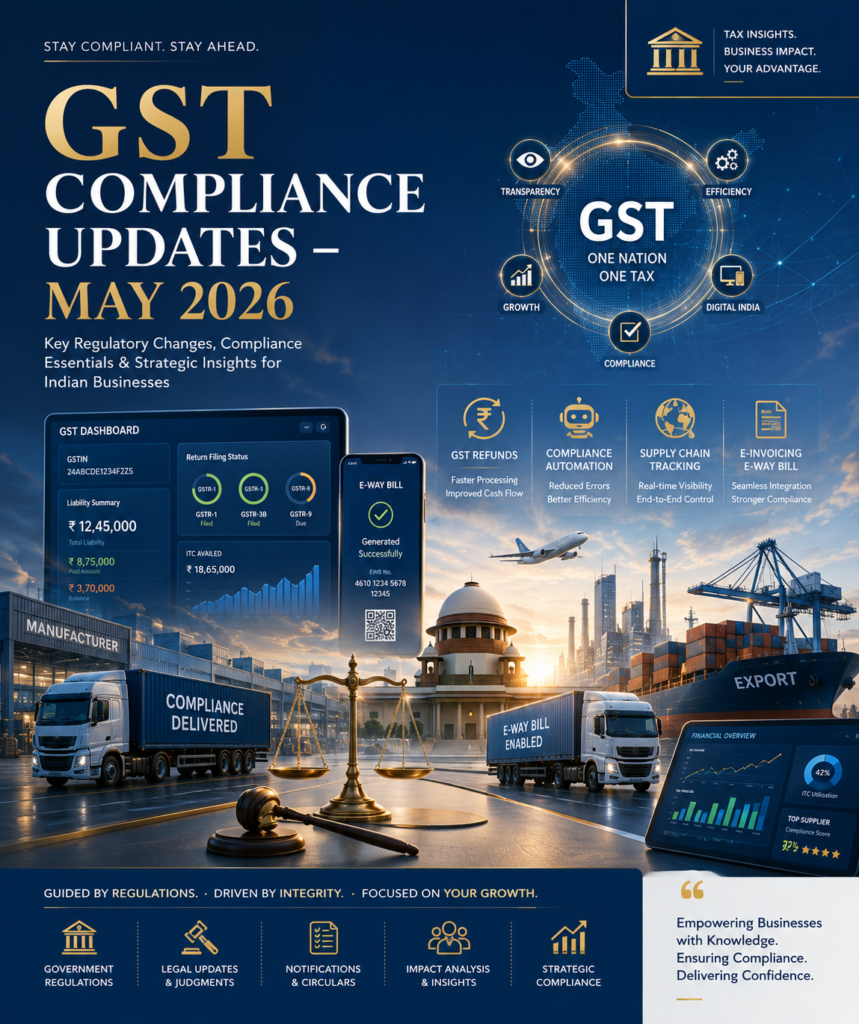
Six developments from GSTN and the GSTAT this month that every compliance team should know.
E-WAY BILL AMENDMENTS
Key E-Way Bill Changes — May / June 2026
GSTN issued a significant advisory on 20–21 May 2026 announcing two operational changes to the e-Way Bill portal, both effective from 15 June 2026. If your business moves goods across India, read this carefully.
🚚 Change 1: Ship-To GSTIN Is Now Compulsory on E-Way Bills
What it means: Many businesses operate on a Bill-To / Ship-To model. For example, a buyer in Mumbai raises the purchase order, but asks the supplier to deliver goods directly to a warehouse in Pune. Until now, the e-Way Bill only captured the GSTIN of the buyer (the Bill-To party). From 15 June 2026, you must also enter the GSTIN of the actual delivery location (the Ship-To party).
If delivery is to an unregistered person or location, type “URP” in the Ship-To GSTIN field. The portal accepts it. If this field is left blank for a Bill-To/Ship-To transaction, the system will refuse to generate the e-Way Bill. No exceptions.
Why this matters: The government wants to trace the actual final destination of every consignment, not just the invoicing party. This plugs circular trading and ghost movements. ERP systems, billing software, and API integrations all need to be updated before the deadline.
WHAT THIS MEANS FOR YOU
Review your billing process immediately. If your business regularly ships to locations different from where the invoice is raised — common in FMCG, manufacturing, trading, and e-commerce fulfilment — ensure your software team adds Ship-To GSTIN as a mandatory field before 15 June 2026. From that date: missing GSTIN = no e-Way Bill = trucks cannot move. Penalty for moving goods without a valid e-Way Bill: 200% of tax payable, or 50% of the value of goods, whichever is higher.
✅ Change 2: You Can Now Voluntarily Close an E-Way Bill After Delivery
What it means: Currently, e-Way Bills expire on their own once the validity window ends. But many bills remain open in the system even after goods are delivered because there was no mechanism to formally close them. This creates messy records and mismatch flags during audits.
From 15 June 2026, GSTN has introduced a voluntary closure facility. Once goods reach their destination, anyone connected to the transaction — the supplier, recipient, transporter, or even the driver — can formally close the e-Way Bill on the portal. Closure must happen on the same day of delivery or by the following day.
This is particularly useful when: (a) a consignment is cancelled mid-route, (b) goods are returned to sender, (c) only a partial delivery is made, or (d) the EWB still shows active after delivery is complete.
WHAT THIS MEANS FOR YOU
Train your dispatch and logistics team to close e-Way Bills on the day of delivery. Once GSTN issues the operational guidelines (expected separately), build this into your daily dispatch closing process. Clean e-Way Bill records reduce audit risk and make GST scrutiny far less painful.
GST REFUND AMENDMENTS
What Changed in GST Refunds — May 2026
Two significant developments in May 2026 have reshaped how GST refunds are filed and processed. One is a mandatory new portal requirement. The other is a major relief for exporters that is now firmly settled.
📋 Annexure-B Refund Filing: PDF Is Dead. JSON Utility Is Now Mandatory.
What changed: If you claim a GST refund for accumulated Input Tax Credit (ITC) — as an exporter under LUT, a supplier to Special Economic Zones, or a manufacturer with an Inverted Duty Structure where tax on inputs is higher than tax on your final product — you must file Annexure-B as part of Form RFD-01.
Until 17 May 2026, this was a manually prepared PDF. That is now over. From 18 May 2026, Annexure-B must be prepared through a dedicated Excel-based offline utility downloaded from the GST portal, and uploaded in JSON format. The portal rejects PDFs outright.
What the new utility requires: Every purchase invoice must be entered individually. Each entry must carry the correct HSN or SAC code. Inputs, input services, and capital goods are classified in separate tables. The utility cross-validates your data against GSTR-2B and flags mismatches automatically. It enforces a limit of 10,000 line items per file, with up to 25 files allowed per application. After validation, it generates a JSON file that you upload on the RFD-01 screen. The portal then auto-computes the eligible refund.
WHAT THIS MEANS FOR YOU
Before you start filling the utility, reconcile your Purchase Register against GSTR-2B. Any invoice in your books that does not appear in GSTR-2B will be rejected at validation. Always download the latest version of the Refund Offline Tool from www.gst.gov.in — using an outdated version is the most common cause of filing errors. If your refund application involves more than 10,000 invoices, split the data into multiple files.
CGST RULES AMENDMENT MAJOR RELIEF FOR EXPORTERS EFFECTIVE OCT 2024 — NOW FULLY SETTLED
📦 Export Refund Relief: Rules 96(10), 89(4A) and 89(4B) Are Gone
Background: For years, exporters who purchased inputs under government incentive schemes — EPCG, Export Oriented Units (EOU), Merchant Export notifications, or STPI — faced a painful double restriction. Rule 96(10) barred them from claiming an IGST refund at all. Rules 89(4A) and 89(4B) forced a separate, complex refund formula that consistently produced a lower figure. Businesses received notices, summons, and large demand orders over these rules.
What changed: Following the 54th GST Council meeting, all three rules were omitted from the CGST Rules with effect from 8 October 2024. By May 2026, this deletion is fully settled — courts including the Bombay, Kerala, and other High Courts have quashed pending SCNs and demand orders that relied on these rules.
What it means now: Every exporter is on equal footing. Whether you availed EPCG, procured from EOU units, or used merchant export rates — your ITC refund is now computed under a single, uniform formula under Rule 89(4). IGST refunds on exported goods are freely available regardless of what input procurement benefit you took. The export refund process is the most straightforward it has ever been under GST.
WHAT THIS MEANS FOR YOU
If your business received an SCN or demand order citing Rule 96(10) or Rules 89(4A)/(4B) and the matter is still pending — challenge it now using the omission notification and the relevant High Court rulings. If you have been getting lower refunds because of these rules, calculate the differential and file a fresh refund claim within the 2-year limitation period. Also check past rejected or reduced applications — they may be eligible for re-filing or rectification under the corrected legal position.
LANDMARK JUDGEMENTS
What the Courts Decided in May 2026
SUPREME COURT AGAINST TAXPAYER (GAMING CO.)
Online Games with Real Money — 28% GST on Full Stakes, Retrospectively
Case: DGGI v. Gameskraft Technologies Pvt. Ltd. and 50+ connected matters (Dream11, Delta Corp, Games24x7 etc.)
What happened: For years, online gaming platforms argued they were simply technology service providers and should pay 18% GST only on their platform fee. The GST department disagreed, insisting that 28% GST was owed on the entire amount deposited by players — not just the commission.
The Supreme Court sided firmly with the government. Once real money is on the line, even a skill-intensive game like Rummy is treated as betting and gambling for GST purposes. These platforms are not intermediaries — they are the suppliers of the gaming experience, and GST at 28% applies on the total pool of money collected from players.
Critically, the ruling is retrospective — companies owe this tax even for transactions before the October 2023 amendment. Total tax demands across all affected companies have been estimated at ₹1.5 to 2.5 lakh crore. The ruling restores the original show-cause notice against Gameskraft demanding ₹21,000 crore, overturning a 2023 Karnataka High Court order that had quashed it.
WHAT THIS MEANS FOR YOU
If you run any business involving online games, contests, prize pools, or fantasy sports with entry fees, this judgment demands an urgent GST review with your tax advisor. For individual players, it may eventually affect platform fees and game viability.
SUPREME COURT IN FAVOUR OF TAXPAYER
Selling Your MIDC / Industrial Plot? No GST on the Transfer
What happened: Imagine you hold a factory plot in an MIDC industrial estate and want to transfer your leasehold rights to another party with MIDC’s permission. The GST department had been claiming that such a transfer is a ‘service’ and should attract GST on the sale consideration.
The Supreme Court disagreed. It confirmed that transferring leasehold rights in industrial land is a transfer of immovable property — not a supply of service under the CGST Act. Since such a transaction has no connection to the regular business activity of the seller, GST does not apply.
WHAT THIS MEANS FOR YOU
Manufacturers and business owners in MIDC, GIDC, SIPCOT, or similar industrial estates need not pay GST when transferring leasehold plots. If you have already paid GST under protest on past transactions of this kind, explore filing a refund application under Section 54 of the CGST Act — within two years of the date of payment.
KARNATAKA HIGH COURT REVENUE’S FAVOUR 30 MAY 2026
The 2-Year Deadline for GST Refunds Is Strict. No Routine Extensions.
Case: Asst. Commissioner of Central Taxes v. Merck Life Science
What happened: Under GST law, refund claims — whether for excess tax paid, export refunds, or accumulated ITC — must be filed within two years. A company missed this window and asked the court to condone the delay.
The Karnataka High Court said no. The two-year limit is mandatory. While a High Court may entertain truly exceptional cases under its constitutional powers, this is not a general right and will not be available as a routine option. Businesses cannot bank on courts bailing them out after they miss the deadline.
WHAT THIS MEANS FOR YOU
Audit your refund entitlements now. If you have accumulated ITC, pending export refunds, or excess tax payments that you have not yet claimed, check whether the two-year window is approaching. Once it closes, it is very difficult to re-open. Set calendar reminders the moment any refund entitlement arises.
ALLAHABAD HIGH COURT & OTHERS IN FAVOUR OF TAXPAYER
GST Notice After Registration Cancellation Must Be Served Physically
What happened: After a GST registration is cancelled, the taxpayer is no longer expected to log into the GST portal. Yet departments were uploading show-cause notices on the portal and treating that as valid service, leading to ex-parte demand orders where businesses had no idea a case was running against them.
Multiple High Courts — including Allahabad — have now held that physical service (registered post or direct delivery) is mandatory for notices issued after cancellation of registration. Uploading on the portal does not count. Orders passed without proper notice violate natural justice and are liable to be set aside.
WHAT THIS MEANS FOR YOU
If your GST registration was cancelled and you have received a tax demand that you were never informed about, you have a strong case to challenge the order on the ground that notice was not properly served. Raise this defence early in any appeal or writ petition.
TELANGANA HIGH COURT MIXED — BOTH SIDES
GST Arrest Powers: When Is It Valid — and When Is It Not?
Case: Rishi Nand Kishore Gupta v. Union of India
What happened: The GST law gives officers power to arrest in cases of serious tax evasion. A taxpayer challenged his arrest, arguing that being ‘held back’ during a search was not the same as a formal arrest.
The Telangana High Court clarified two things: (1) A formal arrest under the GST Act is valid only when there is actual material evidence on record — not mere suspicion or preliminary inquiry. (2) Being asked to stay during a search or inspection is a routine procedural step, not an illegal detention or arrest. Habeas corpus petitions on that ground alone will not succeed.
WHAT THIS MEANS FOR YOU
If officers conduct a GST search at your premises, cooperate professionally. Being asked to remain during the search is standard procedure. However, if you are formally arrested, verify through your lawyer that there is proper documented evidence and that the Section 69 procedure has been strictly followed.