

CSR Through ZCZP Bonds: MCA Introduces a New Avenue for Social Finance
The Ministry of Corporate Affairs (“MCA”), through the Companies (Corporate Social Responsibility Policy) Amendment Rules, 2026 notified on May 27, 2026, has introduced an important development in the Corporate Social Responsibility (“CSR”) framework by permitting eligible companies to undertake CSR expenditure through subscription to Zero Coupon Zero Principal Instruments (“ZCZPIs”) issued by eligible Not-for-Profit Organisations (“NPOs”) registered with Social Stock Exchanges (“SSEs”).
The amendment seeks to bridge the gap between India’s emerging Social Stock Exchange framework and the existing statutory CSR regime under Section 135 of the Companies Act, 2013, thereby creating a potential new channel for corporate funds to reach social-sector organisations.
Background: Connecting CSR with Social Stock Exchanges
Since the introduction of the Social Stock Exchange concept in India, discussions have been underway regarding its integration with the country’s established CSR framework.
The SSE framework, introduced in 2022, provides a structured platform for eligible NPOs and social enterprises to raise funds for social and developmental activities. However, despite the existence of a statutory obligation on certain companies to undertake CSR expenditure under Section 135 of the Companies Act, there was, until recently, no direct mechanism for companies to utilise their CSR funds through the SSE framework.
The MCA’s latest amendment seeks to address this gap by recognising subscription to ZCZPIs issued by eligible NPOs listed on SSEs as an eligible mode of undertaking CSR expenditure, subject to prescribed conditions.
Understanding Zero Coupon Zero Principal Instruments
Zero Coupon Zero Principal Instruments, commonly referred to as ZCZPIs or ZCZP Bonds, are instruments through which eligible NPOs can raise funds on a Social Stock Exchange.
As the name suggests, these instruments carry neither interest nor repayment of principal. In substance, they operate more like structured philanthropic contributions rather than conventional debt instruments. The amount invested by the contributor is not expected to be repaid, and no return by way of interest is payable.
ZCZPIs are recognised as securities under the Securities Contracts (Regulation) Act, 1956 (“SCRA”). Their listing on SSEs subjects the issuing NPOs to a framework of disclosures, reporting and transparency requirements.
Accordingly, ZCZPIs seek to combine the characteristics of a financial security with the underlying objective of social contribution.
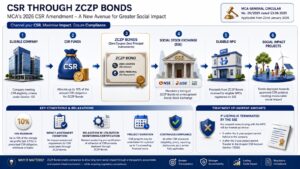
CSR Through ZCZPIs – Key Conditions
The Amendment Rules prescribe certain conditions and relaxations for companies seeking to undertake CSR expenditure through subscription to ZCZPIs.
1. Cap of 10% of Annual CSR Obligation
CSR expenditure through ZCZPIs has been restricted to a maximum of 10% of the company’s total CSR obligation for a financial year.
Therefore, companies cannot utilise their entire annual CSR obligation through ZCZPIs and must continue to undertake the balance CSR expenditure through other permissible activities and modes.
2. Exemption from Impact Assessment
Projects funded through ZCZPIs have been provided an exemption from the requirement of undertaking an impact assessment.
This provides a compliance relaxation to companies subscribing to such instruments, considering the additional regulatory oversight applicable to NPOs raising funds through the SSE framework.
3. Relaxation in Monitoring and Utilisation Certification
The Amendment Rules also provide certain relaxations relating to the monitoring of utilisation of CSR funds.
The management of the company subscribing to ZCZPIs is not required to independently satisfy itself regarding the utilisation of the amount disbursed or obtain the corresponding certification from the Chief Financial Officer (“CFO”), in addition to the continuous monitoring requirements applicable to CSR projects.
One of the underlying considerations appears to be the existing reporting framework applicable to NPOs registered with SSEs.
Under the SEBI Listing Regulations, NPOs are required to submit periodic statements relating to the utilisation of funds to the SSE. Such reporting requirements provide an additional layer of transparency and monitoring over the utilisation of funds raised through ZCZPIs.
When Will ZCZPIs Qualify as CSR Expenditure?
Importantly, not every subscription to a ZCZPI will automatically qualify as CSR expenditure.
The Amendment Rules prescribe specific conditions that must be fulfilled for the expenditure to be considered eligible CSR spending.
Project Duration
The duration of the project undertaken through the ZCZPI should not exceed three succeeding financial years from the date of issuance of the ZCZPI.
This condition broadly aligns the framework with the concept of an ongoing project under the CSR provisions.
Treatment of Unspent Amount
In case the listing of the ZCZPI is terminated, any unspent amount is required to be transferred to a fund specified under Schedule VII of the Companies Act, 2013, along with submission of the prescribed compliance report to SEBI.
Thus, the framework ensures that CSR funds remain earmarked for social purposes and are not retained indefinitely by the implementing organisation without being utilised for the intended project.
A Step Towards Greater Integration of CSR and SSE
The amendment represents an important step towards creating greater synergy between two significant components of India’s social-finance ecosystem — Corporate Social Responsibility and Social Stock Exchanges.
The SSE framework has been developed with the objective of providing social enterprises and NPOs with a regulated platform to raise funds while ensuring greater transparency and accountability. However, one of the key challenges has been the mobilisation of sufficient funds through the platform.
Recognition of ZCZPIs as an eligible CSR avenue could potentially address this challenge by creating a direct link between the substantial CSR spending undertaken by corporates and the fundraising mechanism available through SSEs.
SEBI has also taken steps to encourage NPOs registered with SSEs to utilise the platform for raising funds through ZCZPIs, including requirements relating to the listing of such instruments within the prescribed period following registration.
Conclusion
The recognition of ZCZPIs within the CSR framework marks a significant regulatory development and reflects the continued efforts of regulators to strengthen India’s Social Stock Exchange ecosystem.
By allowing companies to deploy a limited portion of their CSR obligation through ZCZPIs, the MCA has created a potential bridge between corporate CSR capital and social-sector organisations operating through SSEs.
However, the practical success of the framework will ultimately depend on the extent to which companies adopt this mechanism and the ability of NPOs to effectively utilise the SSE platform for fundraising.
While the amendment creates an additional avenue for CSR spending, it remains to be seen whether it can materially increase the flow of corporate funds towards SSE-listed NPOs and contribute to the broader development of India’s social-finance ecosystem.
In essence, the amendment is not merely a new mode of CSR expenditure; it represents an attempt to build a stronger institutional connection between corporate philanthropy, regulated social finance and measurable social impact.