
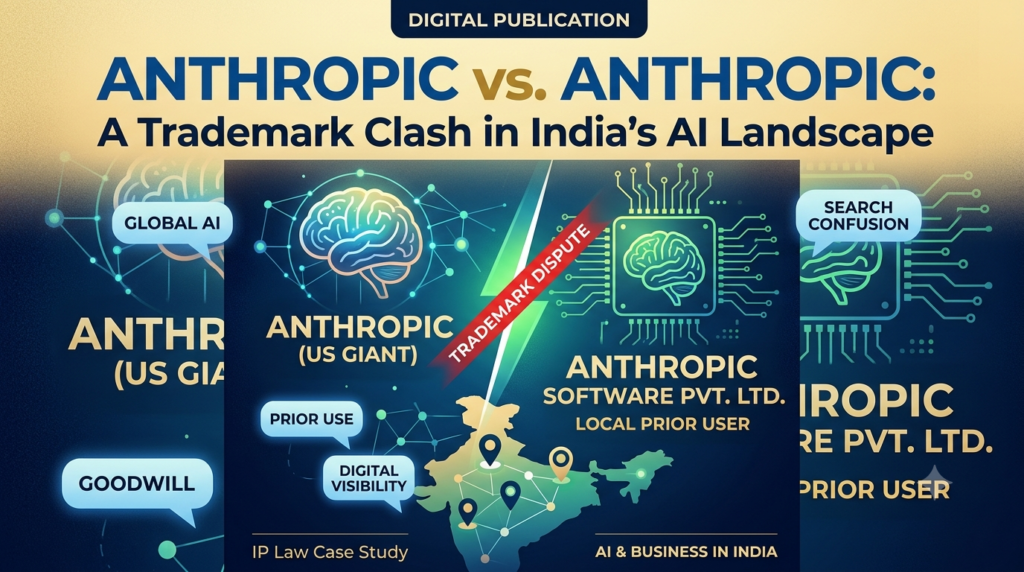
As global AI companies rapidly expand into India, intellectual property disputes are becoming increasingly common. A recent trademark dispute involving US-based AI company Anthropic and Karnataka-based Anthropic Software Private Limited highlights the growing importance of trademark protection in the digital and AI era. The dispute arose after the Indian company alleged that the US AI giant’s entry into India under the name “Anthropic” created confusion among customers and negatively impacted its online visibility and business identity. The Indian company claims it has been using the “Anthropic” name since 2017, years before the US company’s expansion into India.
BACKGROUND OF THE DISPUTE
The Karnataka-based company filed a trademark infringement and passing off suit before the Commercial Court in Belagavi. According to the pleadings, both entities operate within the technology and AI ecosystem, increasing the likelihood of public confusion. The plaintiff alleged that searches for its business increasingly redirected users toward the globally recognized AI company, thereby affecting its goodwill and digital presence.
The court reportedly issued summons to the US company after its representatives failed to appear before the court in earlier proceedings. However, the court initially declined to grant an ex-parte interim injunction, observing that there was insufficient material at that stage to establish active infringement operations in India.
KEY LEGAL ISSUES INVOLVED
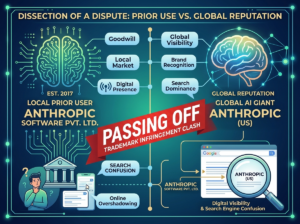
Prior Use vs. Global Reputation
Indian trademark law strongly recognizes the rights of a prior user. Even if a multinational corporation enjoys global recognition, a local business that can establish earlier use in India may still have enforceable rights.
Passing Off
The case primarily revolves around the tort of passing off, where the plaintiff must establish:
- Goodwill associated with its mark,
- Misrepresentation causing public confusion, and
- Likelihood of damage to its business or reputation.
- Digital Visibility and Search Engine Confusion
An interesting dimension of this dispute is the impact of search engine dominance and AI-driven discoverability. The Indian company argued that its online identity was effectively overshadowed by the global AI brand, raising modern questions about digital trademark conflicts in the internet economy.
 WHY THIS CASE MATTERS
This dispute is significant for startups, technology companies, and international businesses entering India. It demonstrates that:
- Trademark clearance searches in India are critical before market entry,
- Startups with limited scale can still enforce IP rights against global corporations,
- Digital confusion and algorithmic visibility may increasingly become evidence in trademark litigation.
The matter also reflects the growing intersection between AI expansion and intellectual property law, particularly as international AI companies establish operations in India.
TAKEAWAYS FOR BUSINESSES
Businesses entering new jurisdictions should:
- Conduct comprehensive trademark due diligence;
- Secure trademark registrations at an early stage;
- Monitor online brand visibility and digital infringement risks;
- Consider local prior-use rights even where global brand recognition exists.
As AI companies continue expanding globally, trademark disputes involving digital identity, search visibility, and brand confusion are likely to become more frequent.
CONCLUSION
The “Anthropic vs. Anthropic” dispute serves as a reminder that in the digital era, a trademark is more than just a brand name; it represents visibility, credibility, and market identity. For startups and multinational corporations alike, proactive IP protection is no longer optional but essential for sustainable business growth.