
If you run a business in India, you’ve probably had this moment at some point.
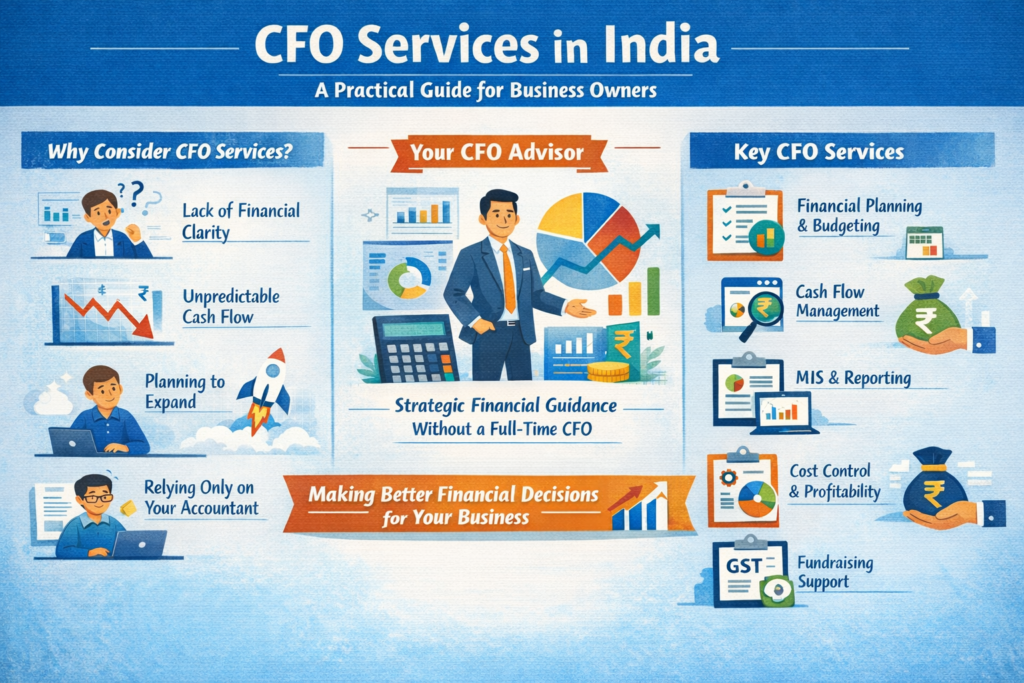
The numbers are there. Sales reports, expenses, GST filings, bank balances. Everything exists. But when it comes to answering simple questions are we actually making money, where is cash going, can we afford to grow things feel unclear.
That gap is where most businesses start thinking about financial support beyond accounting.
And that’s usually when the idea of CFO services comes in.
Not as a title. But as a function the business is missing.
What Does a CFO Actually Do?
A CFO is not someone who maintains books or files returns. That part is already handled by accountants and tax professionals.
The role of a CFO is different.
They help interpret what the numbers are saying and what those numbers mean for the business going forward. It’s less about recording history and more about guiding decisions.
For example, a CFO helps answer questions like whether margins are sustainable, whether expansion is financially viable, or whether current cash flow can support hiring or inventory buildup.
Most founders don’t struggle because they lack data. They struggle because they don’t have clarity.
That’s the gap CFO services are meant to fill.
What Are CFO Services in India?
CFO services in India are a way for businesses to access this level of financial thinking without hiring a full-time Chief Financial Officer.
Instead of building an internal finance leadership team, businesses work with an external advisor who understands their numbers and helps them make better decisions.
This is not the same as outsourcing accounting. The focus is not on filing or bookkeeping.
It is about building a financial layer within the business, something that connects day-to-day operations with long-term decisions.
For many growing businesses, this becomes relevant sooner than expected.
Why CFO Services Are Becoming More Relevant
A few years ago, CFO-level thinking was mostly limited to large companies. Smaller businesses operated with basic compliance and occasional advisory.
That has changed.
Even at relatively smaller scales, businesses today deal with multiple moving parts. There are different revenue streams, vendor credit cycles, digital and offline channels, compliance layers like GST, and sometimes investor expectations.
At that point, bookkeeping alone is not enough.
You need someone who can look at all these pieces together and make sense of them.
That is why CFO services in India are now being used by MSMEs and growing companies, not just large enterprises.
What Happens When You Don’t Have CFO Support
Most businesses don’t immediately feel the absence of a CFO. Things continue to function.
Returns are filed. Payments are made. Sales are growing.
But underneath, small issues start building.
Margins begin to shrink without a clear reason. Cash flow feels inconsistent even in profitable months. Decisions get delayed because there isn’t enough confidence in the numbers.
Nothing feels broken, but nothing feels fully clear either.
Over time, this lack of clarity slows down decision-making. It also increases the chances of mistakes, especially as the business grows.
What Do CFO Services Typically Cover?
CFO services are not delivered as a fixed checklist. They adapt based on what the business needs.
Still, there are some core areas that most CFO engagements focus on.
- Financial Planning and Budgeting
Many businesses operate without a structured financial plan. There may be revenue targets and cost expectations, but not a clear view of how everything fits together.
CFO services help build that structure.
This includes setting budgets, projecting revenues, estimating costs, and understanding different scenarios. The goal is not to predict everything perfectly, but to reduce uncertainty.
- Cash Flow Management
Profitability does not always translate into cash availability. This is one of the most common challenges businesses face.
Payments may be delayed, inventory may lock up capital, and expenses may not align with inflows.
CFO support focuses on tracking and managing cash flow more closely. It helps identify where money is getting stuck and how to improve liquidity.
For many businesses, this alone creates a noticeable difference in stability.
- MIS and Financial Reporting
Most founders get reports.
But not all reports are useful.
A CFO helps build reporting that actually answers questions.
- Monthly performance summaries
- Margin analysis
- Department-level insights
- Variance tracking
Not just numbers.
Context.
Cost Control and Profitability
As businesses grow, costs quietly expand.
More people. More tools. More operations.
Without visibility, margins start shrinking without anyone noticing immediately.
CFO services help identify:
- Where costs are increasing
- Which areas are inefficient
- What can be optimised
It’s not always about cutting costs. Sometimes it’s about spending better.
Compliance and Financial Structuring
While compliance itself may sit with accountants or tax professionals, CFOs look at how it connects to the business.
This includes:
- GST implications
- Tax planning
- Structuring transactions
- Preparing for audits
Often, this overlaps with tax advisory services in India, especially when decisions have long-term financial impact.
Fundraising and Investor Readiness
If you’re planning to raise capital, CFO support becomes critical.
Investors don’t just look at revenue.
They look at:
- Unit economics
- Financial discipline
- Forecasting ability
- Data consistency
CFO services help prepare:
- Financial models
- Pitch numbers
- Due diligence documents
And more importantly, help you answer investor questions confidently.
When Should You Consider CFO Services?
The need for CFO services usually becomes clear through certain signals.
One common sign is growth without clarity. Revenue is increasing, but it is not entirely clear where profits are coming from or why cash feels tight.
Another sign is decision-making without financial backing. Pricing, hiring, or expansion decisions are made based on instinct rather than structured analysis.
Cash flow inconsistency is also a strong indicator. Some months feel comfortable, others feel strained, even when overall performance seems stable.
For many businesses, the need also arises when they are preparing for the next stage, whether that is expansion, scaling operations, or raising funds.
At What Stage Do Businesses Typically Need CFO Services?
Not every business needs CFO support from the beginning.
In the early stage, when operations are simple and transaction volumes are low, basic compliance and accounting are usually sufficient.
As the business moves into the growth stage, complexity increases. This is where confusion around cash flow, costs, and compliance starts to show.
Here are a few practical signals.
- Your business is growing, but you don’t have financial clarity
Revenue is increasing.
But you’re not fully sure where profits are coming from or going.
- You’re making decisions without financial visibility
Pricing, hiring, expansion… decisions are happening, but without structured financial backing.
- Cash flow feels unpredictable
Some months feel comfortable. Others feel tight.
Even when overall numbers look fine.
- You’re preparing for the next stage
This could be:
- Expansion
- Fundraising
- Scaling operations
At this stage, financial discipline becomes more important.
- You rely heavily on your accountant for everything
Accountants are essential. But they’re not meant to drive business strategy. If you’re expecting that from them, there’s a gap.
CFO vs Accountant vs Tax Advisor
There is often confusion between these roles. An accountant focuses on recording and maintaining financial data. A tax advisor ensures compliance and optimises tax-related aspects.
A CFO, on the other hand, focuses on interpreting numbers and guiding business decisions.
All three roles are important, but they serve different purposes.
Most businesses start with the first two. CFO services are usually added as the business grows.
Are CFO Services Expensive?
This is one of the most common concerns.
Hiring a full-time CFO can be expensive, which is why many businesses delay the decision.
However, CFO services in India are structured differently. They provide access to financial expertise without the cost of a full-time role.
More importantly, the value often shows up in avoided mistakes, better decision-making, and improved cash flow.
In many cases, the cost of not having clarity is higher than the cost of advisory.
What Does Working With a CFO Advisor Look Like?
There is a perception that CFO services mean more reports or more complexity.
In reality, the goal is the opposite.
Most engagements involve regular financial reviews, monthly discussions, and guidance on key decisions. Over time, systems improve and processes become clearer.
It is less about adding work and more about reducing uncertainty.
Common Mistakes Founders Make Around Financial Management
Some patterns appear repeatedly across businesses.
Relying only on year-end financials instead of reviewing performance monthly. Assuming profit automatically means cash availability. Making pricing decisions without fully understanding margins.
Another common mistake is delaying financial structuring until issues arise.
These are not technical errors. They are timing issues.
Addressing them early makes a significant difference.
How ATMS Advisors Approaches CFO Services
At ATMS Advisors, we don’t look at CFO services as a fixed package.
Every business comes with different challenges.
Some need help with cash flow.
Some with reporting.
Some with structuring.
The focus is usually the same:
- Understand how the business operates
- Identify where financial gaps exist
- Build systems that actually work in day-to-day operations
Not just reports.
Not just theory.
But something founders can actually use.
A Simple Way to Think About It
If your business is still small and straightforward, basic compliance may be enough.
But once things start getting slightly complex, more transactions, more decisions, more moving parts financial clarity becomes important.
That’s where CFO services come in.
Not as a luxury.
But as support.
Closing Thought
Most founders do not plan to hire a CFO. They realise the need when things stop feeling clear.
When numbers exist but don’t fully explain the business. When decisions feel uncertain. When growth brings complexity.
CFO services do not remove all challenges.
But they make it easier to understand what is happening, and what to do next.
For most growing businesses, that clarity is what actually drives better decisions.
Frequently Asked Questions About CFO Services in India
1. What are CFO services in India?
CFO services provide businesses with financial strategy, planning, and decision-making support without hiring a full-time CFO.
2. How are CFO services different from accounting?
Accounting focuses on recording transactions and compliance, while CFO services focus on analysis, strategy, and business decisions.
3. When should a business consider CFO services?
Businesses should consider CFO services when they face growth, cash flow issues, or lack financial clarity.
4. Are CFO services suitable for small businesses in India?
Yes, many MSMEs and growing businesses use CFO services to improve financial management and decision-making.
5. How much do CFO services cost in India?
Costs vary based on scope, but they are generally more affordable than hiring a full-time CFO.