
Getting Out of the Rat Race
Why Earning More Is Not the Answer — and What Actually Is
Picture the 28th of any month.
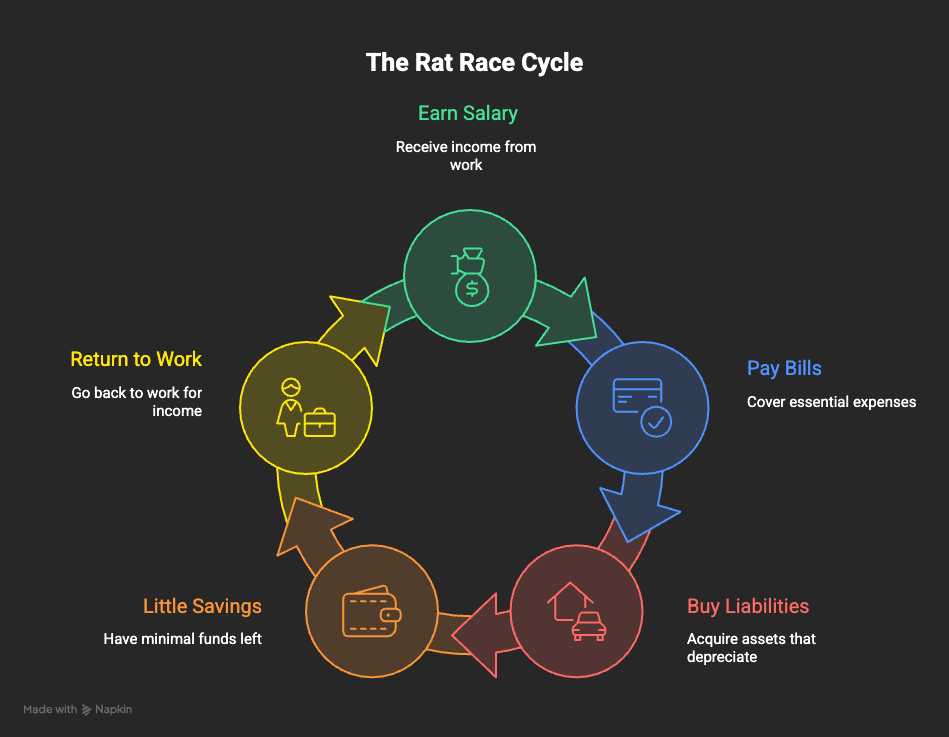
Salary arrived ten days ago. The EMI went out. The rent was paid. The credit card got cleared. Groceries happened. A dinner out, because you deserved it. A subscription renewed that you forgot you had. And now it is the 28th, and the account balance is making you feel vaguely uneasy — despite the fact that you work hard, earn well, and have been telling yourself for years that you need to ‘sort out your finances. This is not a money problem. It is a structure problem. And it has a name. Robert Kiyosaki, in his book Rich Dad Poor Dad, called it the rat race — a financial loop so common and so well-disguised that most people spend their entire careers inside it without ever realising there is a way out. The exit is not a higher salary. It is a different relationship with money entirely.
1. What the Rat Race Actually Is
The rat race is not a metaphor for being stressed or overworked. It is a specific financial condition: your lifestyle requires your active income to function. The moment you stop working — whether by choice, illness, or circumstance — the whole thing stops too.
And here is the part that catches most people off guard: this has nothing to do with how much you earn. An executive on Rs. 5 lakh a month can be just as trapped as someone on Rs. 50,000 — if every rupee that comes in goes straight back out toward EMIs, lifestyle commitments, and growing fixed expenses.
The tell-tale sign is simple: if stopping work, even briefly, would shake your household finances — you are in the. Not because you have failed. But because nobody showed you the exit.
2. The Distinction That Changes Everything: Assets vs. Liabilities
Kiyosaki’s book is built on one idea, and it is deceptively simple. Most people get it wrong the first time they hear it because it cuts against everything we were taught to believe. An asset puts money into your pocket. A liability takes money out. That is the entire framework. The difficult part is not understanding the definition. It is applying it honestly to your own life. Because many of the things we have been told are assets — our homes, our cars, our lifestyle upgrades — are actually liabilities in disguise.
Your home, if it is not generating rental income, costs you money every month in EMIs, maintenance, and property tax. It may appreciate over time. But until it generates cash flow, it is taking money out of your pocket — which makes it a liability, regardless of what the property market says.
✅ Asset — puts money INTO your pocket
🏠 Rental property pays you rent every month
📈 Dividend stocks / MFs credits your account while you sleep
🏢 Business with systems earns without needing you daily
📜 Bonds / REITs generates interest and distributions
❌ Liability — takes money OUT OF your pocket
🚗 Premium car on EMI monthly drain, depreciates daily
🏠 Home (no rental income) EMI + maintenance + tax every month
💳 Lifestyle upgrades on credit takes future income today
The trap: most of what feels like success is in the liability column.
3. Why Earning More Does Not Solve It
This is the uncomfortable truth that most financial advice skips over.
Every time income rises, lifestyle tends to rise with it. The increment becomes a bigger car. The bonus becomes a premium holiday. The promotion becomes a larger flat with a larger EMI. This pattern has a name — lifestyle inflation — and it is the reason why people who earn significantly more than they did five years ago often feel no more financially secure than they did back then.
More income, without a change in structure, simply means more spending at a higher level. The surplus — the portion that could be building assets and generating passive income — gets absorbed before it has a chance to do any real work.
The wealth management principle here is straightforward: pay yourself first. Before lifestyle spending takes over, ring-fence a portion of every rupee that comes in for investment. Not what is left over at the end of the month — because there will almost never be anything left over. What comes off the top, before the spending begins.
4. The Exit Condition — One Equation That Tells You When You Are Free
Kiyosaki is precise about what it means to escape the rat race. It is not a savings milestone. It is not a net worth figure. It is a single test:
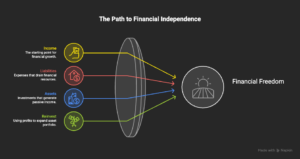
The One Number That Sets You Free
Passive Income > Monthly Expenses
= Your salary becomes optional. This is financial independence.
Where does passive income come from?
- Rent from a property you own
- Dividends from stocks or mutual funds
- Interest from bonds and deposits
- Distributions from REITs
- Profits from a business that runs without you daily
The moment passive income from assets you own exceeds what you need to live on each month, your salary becomes optional. You could stop working tomorrow and your life would not change. That is financial independence — not a number in an account, but a structure that no longer needs you to show up.
Passive income is not passive to build. Assets must be selected carefully, monitored, and managed over time. But once they are earning, they earn whether you are at your desk or not. And that changes everything.
5. How to Get Out — The Structural Approach
The way out is not sudden. There is no moment of dramatic transformation. It is a series of quiet, deliberate redirections of money — away from things that drain it and toward things that grow it.
The sequencing matters. The first asset is always the hardest. It requires delayed gratification, the discipline to invest before spending, and the patience to watch someone else buy the new car while you put that money into something that will not feel rewarding for years.
But here is what Kiyosaki gets exactly right about the compounding effect: once you own one income-generating asset, its output becomes capital for the next one. And the next one funds the one after that. Each additional asset adds to your passive income, pushing you steadily toward that crossover point. The acceleration is real — and it is why people who break out of the rat race often seem to move quickly once they finally get started.
The first asset is slow. Everything after it is funded by assets you already own.
6. Where to Begin — Five Practical Steps
- Review your cash flow honestly. List every outflow and label it: asset or liability. The result will be clarifying, and possibly uncomfortable.
- Create an investible surplus first. Before upgrading anything, direct a fixed percentage of income into investment. Treat it as non-negotiable.
- Build your first income-generating asset. It does not need to be large. A SIP in dividend-yielding funds, a small property, a business side income — start somewhere.
- Reinvest what your assets produce. Every rupee of passive income that comes in goes back into more assets, not into spending.
- Track progress through the right metrics. Not just savings balance — but passive income as a percentage of monthly expenses. Watch that number grow.
The Only Finish Line That Matters
Financial freedom is not about stopping work. Most people who achieve it continue to work — because they want to, not because their monthly obligations leave them no choice.
That distinction — working by choice rather than compulsion — is the whole point. It is what the rat race takes from you, quietly and gradually, until the idea of choosing feels distant and impractical.
It does not have to be. The exit exists. It is structural, not sudden. It is built from decisions made with each pay cheque — to direct a little more toward assets and a little less toward liabilities, consistently, over time.
The treadmill stops when the income from what you own exceeds the cost of how you live. Everything you do between now and that moment either moves you toward it or keeps you running in place.
You are not working for money anymore. Your money is working for you. That is the only finish line that matters.
The exit from the rat race is not a salary. It is a structure.
Build it. One asset at a time.