
If you run a business in India, GST is not a theory. It is a monthly reality. It shows up in your invoicing, your vendor payments, your pricing decisions and, sometimes, your stress levels at the end of the month.
Most GST Compliance issues do not start dramatically. They start quietly. Accounts are slightly delayed. Reconciliation is postponed because the team is busy. A notice arrives and gets parked for later review.
Nothing feels urgent.
Until it becomes expensive.
That is usually how avoidable GST penalties in India enter the picture through small, repeated gaps in process.
Let’s look at where businesses most commonly slip.
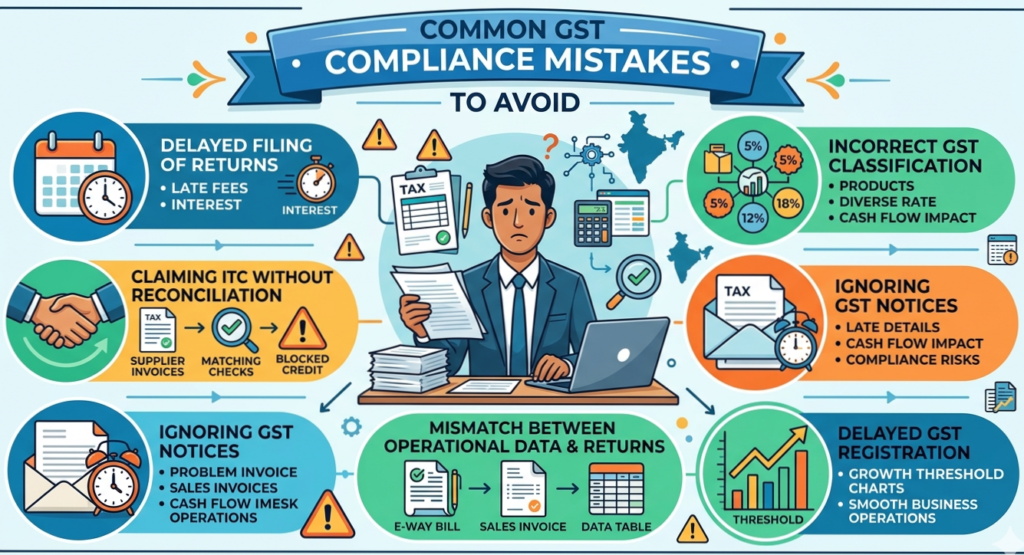
- Delayed Filing of GST Returns
In many growing businesses, return filing gets pushed down the priority list. Sales targets feel more urgent. Vendor payments need attention. Data isn’t fully compiled yet.
So filing is delayed.
A few days may not seem serious. But the late fee meter runs daily. Interest accumulates quietly. And repeated delays build a compliance trail that regulators can see.
The real issue isn’t the fee itself. It’s the habit of treating GST filing as something to finish once everything else is done.
Businesses that avoid this mistake usually do one simple thing differently, they close books monthly, not quarterly. Filing then becomes routine, not reactive.
- Claiming ITC Without Proper Reconciliation
Input Tax Credit is often treated as automatic. If the invoice exists in your system, credit is assumed to be available.
But GST doesn’t work on internal assumptions. It works on matched reporting.
If a supplier hasn’t uploaded the invoice properly, your GSTR-2B won’t reflect it. Claiming credit in that situation can later mean reversal, interest, and explanations.
This is one of the most common GST compliance mistakes and it is rarely intentional.
Businesses that stay out of trouble tend to reconcile monthly. Not because the law sounds threatening, but because liquidity matters. Blocked credit affects cash flow more than most owners realise.
- Incorrect GST Classification
Classification errors are surprisingly common, especially when businesses expand their product or service lines.
Sometimes a rate is copied from an old invoice. Sometimes it is based on what competitors appear to be charging. Occasionally it is simply assumed.
But GST rates are tied to classification, and classification requires review.
An undercharged rate creates exposure. An overcharged rate hurts competitiveness.
Whenever a new offering is introduced or bundled differently, classification deserves a fresh look. It’s a small review that can prevent a large correction later.
- Ignoring GST Notices
A GST notice does not always mean wrongdoing. Many notices arise from mismatches between returns, e-way bills or supplier filings.
The real mistake is delay.
Notices often sit unread for days because they seem procedural. By the time someone examines them carefully, timelines are tighter and explanations feel more urgent.
Responding early usually keeps matters simple. Responding late makes them procedural.
The difference is not legal complexity, it is timing.
- Mismatch Between Operational Data and Returns
In many businesses, dispatch and accounts operate independently. E-way bills are generated. Sales invoices are raised. Returns are filed.
But reconciliation between these systems is sometimes an afterthought.
With increasing automation in GST systems, cross-verification is constant. Inconsistencies surface quickly.
Businesses that avoid scrutiny are usually not those with zero errors, they are those with internal cross-checks before filing.
Coordination between operations and finance reduces surprises.
- Delayed GST Registration
When turnover approaches the registration threshold, compliance sometimes lags behind growth. Revenue increases faster than administrative updates.
Registration then happens later than it should.
The consequence is not just a technical breach. Tax may become payable from the date the threshold was crossed. Customers may resist retrospective billing. Interest may apply.
Monitoring turnover is not just a finance exercise. It is a compliance safeguard.
- Treating GST as Only an Accountant’s Job
This is perhaps the most structural issue.
GST affects pricing strategy, vendor contracts, working capital cycles and expansion decisions. Yet many founders disengage from it entirely, assuming it is purely procedural.
Accountants manage filings. But business owners manage risk.
When leadership understands how GST interacts with margins and cash flow, compliance becomes part of planning, not just reporting.
Practical Do’s and Don’ts
There is no complex formula to avoid GST penalties in India. What works is consistency.
Keep books updated monthly. Reconcile ITC before filing. Review classifications when your offerings change. Track deadlines in advance. Respond to notices quickly.
Avoid filing based on incomplete data. Avoid assuming mismatches will correct themselves. Avoid delaying registration once eligibility arises.
Most penalties arise from postponement.
Why GST Penalties in India Are Becoming More Visible
The GST system today is heavily data-driven. Cross-checks between filings, e-way bills and supplier data happen automatically. Discrepancies surface faster than they used to.
In earlier years, certain inconsistencies might have gone unnoticed for long periods. That is less likely now.
The environment rewards structured systems and exposes loose ones.
The Broader Cost of GST Compliance Mistakes
Penalties are measurable. The indirect effects are less visible.
Blocked ITC impacts liquidity. Vendor mismatches create friction. Notices consume management attention. Corrections divert energy from growth.
Most business owners would rather prevent these issues than resolve them.
Closing Thought
GST compliance mistakes rarely come from deliberate avoidance. They usually come from growth moving faster than internal controls.
As businesses expand across states, increase turnover or diversify offerings, compliance systems must evolve alongside them.
A proactive review today is significantly less expensive than a corrective response later.
Frequently Asked Questions
- We’re a small business. Do GST penalties really apply to us strictly?
Yes. Size doesn’t really protect you. The system is automated now, so delays or mismatches get picked up whether you’re large or small. - If we make a genuine mistake, will we still be penalised?
Usually you’ll have to pay interest if tax was short-paid. Whether a penalty applies depends on the situation. But “genuine mistake” doesn’t automatically mean zero cost. - How often should we actually reconcile GST?
Monthly. Waiting till year-end is where most problems start building up quietly. - Our supplier hasn’t filed properly. Why should that affect us?
Because your ITC depends on their filing. If they don’t upload correctly, your credit may not reflect. It’s frustrating, but that’s how the system works. - Can GST registration really get cancelled?
Yes. Continuous non-filing or ignoring notices can lead to suspension. It disrupts business more than people expect. - Do founders really need to worry about GST, or is this just the accountant’s job?
You don’t need to file returns yourself. But you should understand how GST affects pricing and cash flow. Otherwise, small compliance gaps turn into business risks. - Is there any practical way to stay out of trouble?
Close books every month. Reconcile before filing. Don’t ignore notices. Most GST issues come from postponing things.