
What Is a GST Notice?
A GST notice is an official written communication issued by the GST department to a registered taxpayer. It could ask you to explain a mismatch in your returns, respond to a tax demand, submit documents, or simply file a pending return that you missed.
That’s the technical definition. But here’s what it actually feels like.
The moment you see it, your mind goes straight to worst-case scenarios. What did I miss? Is this serious? Many people in this situation think waiting it out is an option. It really isn’t.
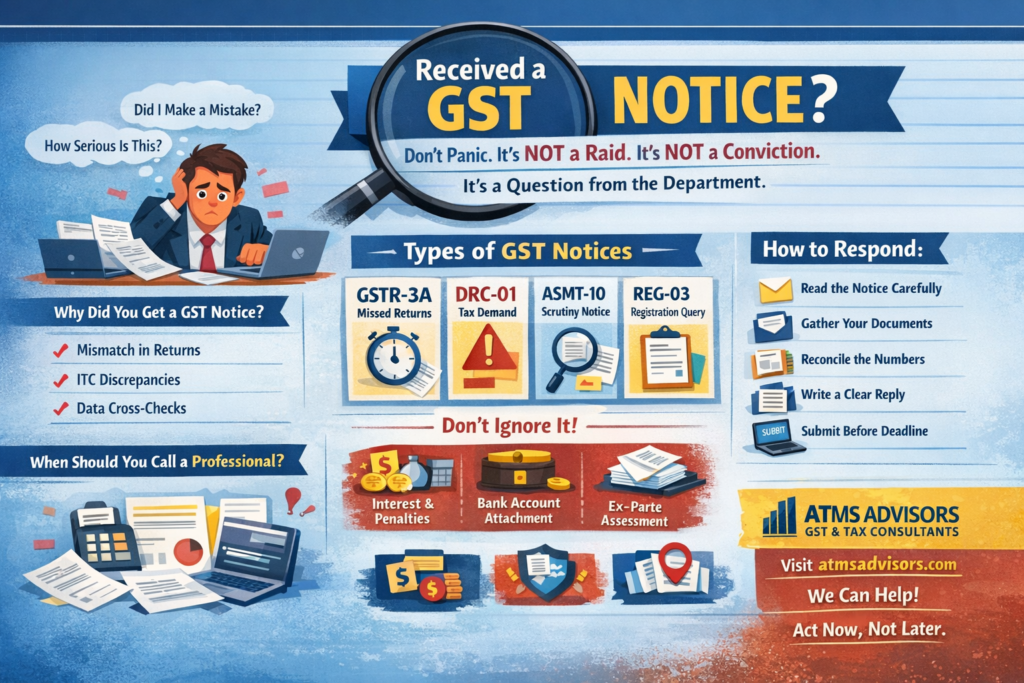
Here’s what I want you to know before anything else: a GST notice is not a raid. It’s not a conviction. The department isn’t assuming you’re dishonest. In most cases, it’s the system doing what it was built to do, cross-checking numbers across millions of filings, and something in yours didn’t line up cleanly. Maybe your supplier filed late. Maybe there’s a small mismatch between your GSTR-1 and your buyer’s GSTR-2B. Maybe your numbers just looked unusual.
So that’s all a GST notice really is. A formal question from the department, asking for your side of the story.
What you do next, how seriously you take it and how carefully you respond, is what determines whether this stays a small administrative task or turns into something much more stressful.
Why Did You Receive a GST Notice?
The GST system runs on data matching. Constantly.
Your GSTR-1 gets compared against your buyer’s GSTR-2B. Your declared turnover gets checked against your income tax filing. Your ITC claims get verified against what your suppliers actually filed. If any of these don’t align, even because your supplier was late or there’s a decimal error somewhere, the system flags it.
A mismatch doesn’t automatically mean fraud. It doesn’t mean negligence either. Sometimes it’s a clerical error. Sometimes a vendor updated an invoice after you already reconciled. Sometimes your business grew quickly and the numbers just looked suspicious to an automated system that doesn’t understand context.
What the department wants is simple: tell us what happened.
The businesses that get into real trouble aren’t the ones who made mistakes. They’re the ones who went quiet after getting a notice. Because silence in GST law is treated as admission. The department doesn’t wait. They assess, they penalise, and they move on.
Don’t go quiet.
Types of GST Notices Explained Simply
GSTR-3A: Notice for Non-Filing of GST Returns
This one usually comes as a wake-up call. If you’ve missed filing your GST returns, whether it slipped, there was a cash flow issue, or you just kept pushing it, GSTR-3A is the department’s way of saying: we noticed. File within 15 days or they’ll assess your liability themselves under Section 62, and their estimate won’t be in your favour.
The good news is that this is one of the more straightforward GST notice types to deal with. File the pending return, clear any late fee, and reply to the notice. In most cases, that’s enough to close it.
DRC-01: Show Cause Notice for Tax Demand
DRC-01 means the department believes you owe them money and they want you to either agree and pay, or explain why they’re wrong. It could stem from an ITC mismatch, short payment of tax, or discrepancies between your returns. Whatever the reason, this notice demands a proper, evidence-backed GST notice reply. Not a one-liner. Not “we’ve checked and everything is fine.” A real, point-by-point response with documents.
DRC-01A: Pre-Show Cause Notice
Think of this as the department giving you a second chance before things get formal. Before issuing DRC-01, officers are increasingly required to issue DRC-01A first, essentially saying: here’s what we found, do you want to sort this out before we make it official? If you take this seriously and respond well, there’s a genuine chance the matter ends right here. Most people underestimate this notice. Don’t.
ASMT-10: GST Scrutiny Notice
This one comes out of a desk review where an officer goes through your returns and spots something that doesn’t add up. It could be a difference between GSTR-1 liability declared versus what was short paid in GSTR-3B. It could be that your ITC reflected in GSTR-2B on the GST portal doesn’t match what was claimed in GSTR-3B. Maybe your turnover in GSTR-1 doesn’t match what you declared in your income tax return.
ASMT-10 is not an allegation. It’s the officer asking: can you help me understand this? Respond with the right documents and a clear explanation, and most scrutiny notices close without escalating further.
REG-03: Notice During GST Registration
If you’re in the middle of applying for GST registration and suddenly get a notice, don’t panic. This is routine. REG-03 just means the officer reviewing your application needs something more, whether that’s an additional document, a clarification about your business address, or proof of something. It’s administrative. Respond within the time given with exactly what they’ve asked for, and your registration process moves forward.
What Happens If You Ignore a GST Notice?
Let me be direct here because this part matters.
A lot of people, especially first-timers, see a GST notice, feel overwhelmed, and convince themselves that if they just wait a bit, it’ll sort itself out. It never does.
Here’s the actual sequence of what happens when you don’t respond. The department issues an ex-parte order, meaning they make a decision about your tax liability without your side of the story, and they are not conservative about it. Then interest at 18% per annum starts running from the original due date. Then penalties get layered on, 10% of tax under Section 73 for non-fraud cases, going all the way up to 100% under Section 74 if fraud is alleged. And if the amount is significant, they have the power to attach your bank account or business assets while the matter is pending.
An imperfect reply is always, always better than no reply.
How to Write a Correct GST Notice Reply: Step by Step
Step 1: Read the Notice Properly
Not a skim. An actual read. Find out which section it’s been issued under. Understand specifically what discrepancy or query has been raised. Note the deadline.
Step 2: Gather All Relevant Documents
Before you write a single word of your reply, get your paperwork in order. Invoices, GST returns, bank statements, e-way bills, purchase registers, reconciliation reports, whatever is relevant to what the notice is questioning. Your GST notice reply is only as strong as the evidence behind it.
Step 3: Actually Reconcile the Numbers
Don’t assume you know where the discrepancy is. Sit down with your GSTR-1, GSTR-3B, and GSTR-2B data and find it. Sometimes you’ll discover it’s a vendor who filed late and created a mismatch in your 2B. Sometimes it’s a genuine error in your own returns. Sometimes it’s a portal glitch that’s since been corrected. Whatever it is, document it clearly before you respond.
Step 4: Write a Point-by-Point Reply
Go through the notice observation by observation and address each one directly. No vague language. No “everything is in order.” Name the specific invoice, the specific return period, the specific reconciliation report. Attach the document. Explain what it shows. Make it impossible for the officer to say your reply didn’t address the question.
Step 5: Submit Before the Deadline
Log in to gstin.gov.in and go to Services, then User Services, then View Notices and Orders. Find your notice, attach everything, and submit. Download and save the acknowledgment the moment it generates. That acknowledgment is your proof that you responded, and you may need it later.
Step 6: Follow Up If You Hear Nothing
Submission isn’t the end. If the notice remains open on the portal after a reasonable time and you haven’t received any further communication, follow up. Don’t sit back and assume no news is good news.
Common Mistakes to Avoid When Replying to a GST Notice
The reply is where most people lose cases they should have won.
Responding after the deadline is the most damaging mistake because it removes your right to be heard in many situations. Writing a generic response without addressing each specific point signals to the officer that you haven’t taken the notice seriously. Uploading incomplete documents, or documents that don’t actually support what you’re claiming, weakens your position considerably. And perhaps the most painful one: admitting to errors in your reply that didn’t actually exist, simply because you panicked and second-guessed yourself.
One more thing that most people forget: always mention in your reply that a personal hearing is required before any adverse decision is made. That’s your right under GST law, and it’s worth stating clearly.
Stay factual. Stay calm. Stay specific.
When Should You Hire a GST Professional?
Honestly, not every notice needs one.
If you’ve received a GSTR-3A because a return slipped through the cracks, you can probably sort that out yourself. File the return, pay the fee, close the notice.
But the moment your situation involves any of the following, please don’t handle it alone. A tax demand above Rs. 2 lakh. Any allegation involving fake invoices or ITC fraud. Multiple notices across different financial years. A notice that pulls in income tax or customs data. Or anything issued under Section 74, which is where fraud and wilful suppression territory begins.
In these cases, the GST notice reply you file isn’t just a response. It becomes part of the record. One wrong admission, one poorly worded paragraph, and you’ve created a problem that didn’t exist before. The cost of getting it wrong is almost always higher than the cost of getting help.
Frequently Asked Questions About GST Notices
What is a GST notice?
A GST notice is an official communication from the tax department asking you to explain a discrepancy, respond to a tax demand, file a pending return, or provide documents. It is not automatically an indication of wrongdoing. In many cases it’s a routine administrative query.
How many days do I have to reply to a GST notice?
It depends on the notice type. GSTR-3A gives you 15 days. Most show cause notices allow 30 days, though you can request an extension in genuine cases. The deadline is always mentioned in the notice itself, so check it first.
What happens if I don’t reply to a GST notice?
The department proceeds with an ex-parte assessment, meaning they determine your tax liability without your input. Interest at 18% per annum, penalties, and potentially bank attachment follow. There is no benefit to staying silent.
Can I reply to a GST notice myself?
For simpler notices like GSTR-3A, yes, in most cases you can. For anything involving large demands, ITC disputes, or allegations of fraud, working with a qualified GST professional significantly improves your outcome.
What is the difference between DRC-01 and DRC-01A?
DRC-01A comes first. It’s an informal opportunity to pay or explain before things become formal. DRC-01 is the actual show cause notice that requires an official, documented reply. If you receive DRC-01A, treat it seriously because a good response here can prevent DRC-01 from being issued at all.
How do I reply to a GST notice online?
Log in to gstin.gov.in and go to Services, then User Services, then View Notices and Orders. Locate your notice, prepare your reply, attach supporting documents, and submit before the deadline. Save the acknowledgment once it’s generated.
The Bigger Picture
Here’s something worth saying plainly.
Businesses that handle GST notices well, the ones that close cases cleanly, avoid penalties, and protect their ITC, they’re not necessarily the ones with perfect compliance records. They’re the ones who don’t freeze when something unexpected lands in their inbox. They know what to do, or they know who to call.
That’s not luck. That’s preparation.
At ATMS Advisors, we work with businesses across India, from traders and startups to mid-size companies and large corporates, and a big part of what we do is exactly this. Helping people understand what a notice actually means, what their options are, and how to respond in a way that closes the matter rather than extending it.
If you’ve got a GST notice sitting in your inbox right now and you’re not sure what to do with it, reach out. Not after the deadline. Now.
Visit atmsadvisors.com or send us a message. We’ll look at it together and figure out the right move.