
The Big Picture, Why This Matters to You
GST was introduced in July 2017. But for eight long years, there was one massive gap in the system: if the GST department issued a demand against you, and you lost your first appeal before the Commissioner (Appeals), you had nowhere to go except the High Court; which is expensive, slow, and designed for constitutional questions, not everyday tax disputes.
That gap is now officially closed.
The GST Appellate Tribunal, known as GSTAT; is now fully operational. It was formally launched by Finance Minister Nirmala Sitharaman on 24 September 2025 and began hearing actual cases from 16 February 2026. It is the dedicated court for GST disputes, sitting between the first appellate authority (Commissioner Appeals) and the High Court.
What is GSTAT, in simple terms?
Think of it as the ‘GST Court.’ It is a specialised tribunal, like the Income Tax Appellate Tribunal (ITAT) for income tax, staffed by retired High Court judges (Judicial Members) and senior tax officers (Technical Members). It exists for one purpose: to give taxpayers a fair, affordable, and specialised second hearing if they disagree with the order of the Commissioner (Appeals).
Why Is March 2026 a Critical Month?
There is a hard, non-extendable deadline that directly affects your business if you have received any adverse GST order in the past few years.
DEADLINE ALERT – 30 JUNE 2026
All GST appeals arising from orders issued up to 31 March 2026 must be filed before GSTAT by 30 June 2026. After this date, these appeals will become time-barred. You will permanently lose your right to challenge those orders at the tribunal level.
This means: if you received an adverse Order-in-Appeal (i.e., the Commissioner Appeals decided against you) at any point between 2017 and March 2026, and you have not yet filed a second appeal, you must act before 30 June 2026.
The staggered filing schedule based on order date is as follows:
|
Order / OIA Issued During |
GSTAT Filing Window Opens | Final Deadline |
|
Up to 31 Jan 2022 |
24 Sep 2025 | 30 Jun 2026 |
|
1 Feb 2022 – 28 Feb 2023 |
1 Nov 2025 | 30 Jun 2026 |
| 1 Mar 2023 – 31 Jan 2024 | 1 Dec 2025 |
30 Jun 2026 |
| 1 Feb 2024 – 31 May 2024 | 1 Jan 2026 |
30 Jun 2026 |
| 1 Jun 2024 – 31 Mar 2026 | 1 Feb 2026 |
30 Jun 2026 |
Who Should Be Checking Their Records Right Now?
Ask yourself, or your accountant; these three questions:
Question 1 – Do you have any pending GST demand that went against you at the first appeal stage?
If yes, that is an Order-in-Appeal (OIA). If you have not filed a second appeal, you may still be able to do so before GSTAT — provided the 30 June 2026 deadline is not missed.
Question 2 – Do you have a GST demand that you accepted and paid, even though you believed it was wrong?
If the demand arose from an order that was never properly contested, you may still have a right to appeal if the time limit has not expired. Check with your advisor immediately.
Question 3 – Did you receive an SCN or demand during 2020–2025 for ITC reversal, GST on exempt supplies, RCM non-payment, or valuation disputes?
These are the most common categories of second-appeal eligible disputes. If any of these resulted in an OIA against you, check whether GSTAT filing is still possible.
How Does a GSTAT Appeal Work? – Step by Step
Here is the full process in plain language, so you know exactly what to expect:
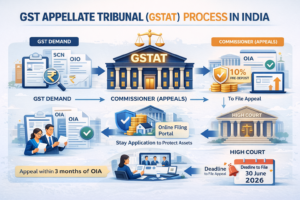
01 Collect your Order-in-Appeal (OIA)
This is the written order where the Commissioner (Appeals) decided against you. You need this document. If you filed the first appeal online, the OIA should be on your GST portal under ‘Notices and Orders’. If it was a manual appeal, you need to obtain a certified copy.
02 Engage your GST advisor / CA
Prepare the Grounds of Appeal — the specific legal and factual reasons why the OIA is wrong. These must be numbered and clearly stated. You cannot add new grounds later without the tribunal’s permission.
03 Pay 10% pre-deposit (mandatory)
You must deposit 10% of the disputed tax and penalty amount before the appeal is admitted. This is in addition to the 10% already paid at the first appeal stage. The payment is made online via the GSTAT portal. Maximum cap on this pre-deposit: there is no statutory upper cap, but the total (first appeal + GSTAT) generally cannot exceed 25% of disputed tax in most cases. Pay via the GSTAT portal linked to Bharatkosh.
04 File APL-05 online on the GSTAT portal
Go to efiling.gstat.gov.in. All appeals are mandatory e-filed — no paper submissions accepted. Upload: SCN, OIO (Order-in-Original), OIA, Grounds of Appeal, Statement of Facts, and authorisation (Vakalatnama for advocate or authorisation letter for CA/CMA). Pay the court filing fee: ₹1,000 per ₹1 lakh of disputed amount, capped at ₹25,000. Maximum: ₹5,000 for refund/registration/enforcement order types.
05 Also file a Stay Application simultaneously
This is critical. Once you file an appeal, you can simultaneously apply for a stay of recovery of the remaining 90% of the demand. This prevents the department from attaching your bank account or assets while the appeal is being heard. File a GSTAT FORM-01 as an interlocutory application along with your appeal.
06 Attend hearings and await order
Hearings can be physical or virtual (hybrid mode). You will be notified of the hearing date via SMS and email. The GSTAT is required to decide appeals within a reasonable timeframe. Orders are uploaded digitally and communicated electronically.
What Does It Cost? – A Quick Snapshot
|
Item |
Amount / Basis |
|
Pre-deposit (mandatory) |
10% of disputed tax + penalty (on top of 10% already paid at first appeal) |
|
Court filing fee |
₹1,000 per ₹1 lakh of dispute — maximum ₹25,000 |
| Fee for refund / registration orders |
Flat ₹5,000 |
| Professional fees (CA / Advocate) |
Varies — for most SME matters, expect ₹25,000–₹1,00,000+ depending on complexity |
| Stay application fee |
Included in the main court fee — no separate charge |
The pre-deposit is not a cost, it is a recoverable deposit
If you win the appeal, the pre-deposit amount is refunded along with interest. It is not a penalty or a write-off. Think of it as a security deposit that you get back if the tribunal rules in your favour. The actual unrecoverable cost is only the court filing fee (max ₹25,000) and professional charges.
Real Scenarios, Should You File an Appeal?
Q We received a demand of ₹18 lakhs for ITC reversal on purchases from a supplier who did not file GSTR-3B. We paid the demand but believe it was wrong. Can we still appeal?
A Possibly. If you paid the demand under an OIO (Order-in-Original) or OIA without formally contesting it, the limitation clock may or may not have expired. Check the date of the order. If you are within the appeal window, you can contest. Courts have consistently held that bonafide recipients cannot be penalised for supplier defaults. Consult your advisor urgently.
Q We got an OIA 18 months ago upholding a ₹45 lakh GST demand on RCM. We could not afford to go to High Court. Is it too late?
A Not necessarily. GSTAT has been operational only from September 2025. There was a valid reason (no tribunal available) why you could not file a second appeal earlier. Your OIA falls well within the 30 June 2026 GSTAT window. File the appeal immediately with a 10% pre-deposit (₹4.5 lakhs) and simultaneously apply for a stay on the remaining ₹40.5 lakhs.
Q Our business received a ₹3 lakh demand. Is it worth filing a GSTAT appeal?
A You need to weigh the cost (10% pre-deposit = ₹30,000 + court fee + professional fee) against the merit of your case and the amount at stake. For disputes below ₹2–3 lakhs with weak legal grounds, the economics may not justify an appeal. But if the demand is legally unsound, even a ₹3 lakh dispute is worth contesting, especially if the underlying issue affects future transactions.
Q The department is threatening to attach our bank account for a demand we are contesting. Can GSTAT help?
A Yes. Filing the appeal before GSTAT and simultaneously seeking a stay of recovery is the fastest legitimate way to halt attachment proceedings. Once a stay is granted by GSTAT, the department must pause coercive recovery. Do not wait, file the appeal and stay application before any attachment is executed.
Your Action List – Do This Before 30 June 2026
Hand this list to your accountant today:
✓ Pull all GST orders received since July 2017 – SCNs, OIOs (Orders-in-Original), and OIAs (Orders-in-Appeal)
✓ Identify all OIAs decided against you – These are second-appeal eligible, regardless of whether you paid the demand or not
✓ Check the date of each OIA – Falls in the staggered schedule table above? Your filing window is already open
✓ Do not confuse OIO with OIA – Only OIAs (Commissioner Appeals orders) go to GSTAT, not the first department order
✓ Contact your GST advisor immediately – Share all OIA copies and let them assess merit and pre-deposit liability
✓ Verify your GSTAT portal login – Register at efiling.gstat.gov.in if not already done, use your GSTN credentials
✓ Prepare pre-deposit funds – 10% of disputed tax must be ready before filing, plan your cash flow now
✓ File appeal + stay application together – Don’t file the appeal without also filing the stay, this protects you from recovery
✓ Do not miss 30 June 2026 – There is no provision for condonation of delay beyond this consolidated deadline