INDUSTRIAL RELATIONS CODE, 2020
Understanding India’s Workplace Reform
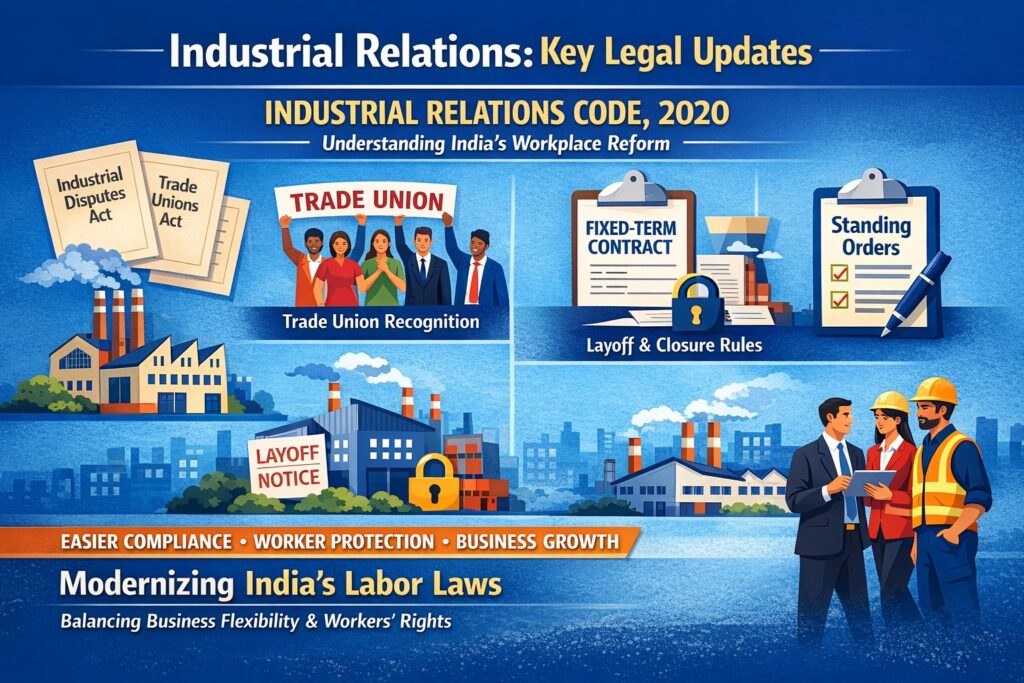
The Industrial Relations Code, 2020 is a major reform aimed at simplifying India’s labor framework. It consolidates three earlier laws:
- Industrial Disputes Act, 1947
- Trade Unions Act, 1926
- Industrial Employment (Standing Orders) Act, 1946
Its objective is to improve ease of doing business while protecting workers’ rights.
Key Highlights
- Recognition of Trade Unions
- A union with 51% worker membership becomes the sole negotiating union.
- If no union meets this threshold, a negotiating council is formed.
Example: In a factory of 400 workers, if 210 workers belong to one union, it becomes the official negotiating body.
- Fixed-Term Employment
- Employers can hire workers for a fixed period contract.
- Fixed-term employees must receive equal wages and statutory benefits as permanent employees.
Impact: Encourages formal hiring in sectors like manufacturing, IT, and infrastructure.
- Threshold for Layoffs & Closure
- Government approval required for layoffs, retrenchment, or closure in establishments where the number of workers exceed 300 (earlier limit: 100).
Example: A steel fabrication unit employing 275 workers faces a demand slowdown. As the workforce is below 300, the employer can proceed with retrenchment without prior government approval, while still paying mandatory compensation and notice pay as prescribed under the Code.
- Workers must give 14 days’ notice before a strike.
- Employers must follow similar notice rules before a lockout.
This aims to reduce sudden industrial disruptions.
- Standing Orders
- Mandatory for establishments with 300 or more employees.
- Clearly defines service conditions, misconduct rules, and termination policies.
Why It Matters
- Promotes industrial harmony
- Simplifies compliance
- Encourages investment and business growth
- Strengthens structured dispute resolution

Conclusion
The Industrial Relations Code, 2020 represents a significant step toward a modern labor framework. It provides businesses with greater operational flexibility while ensuring workers receive fair treatment and formal protections.
For employers and HR professionals, understanding these changes is essential to remain compliant and future-ready.