
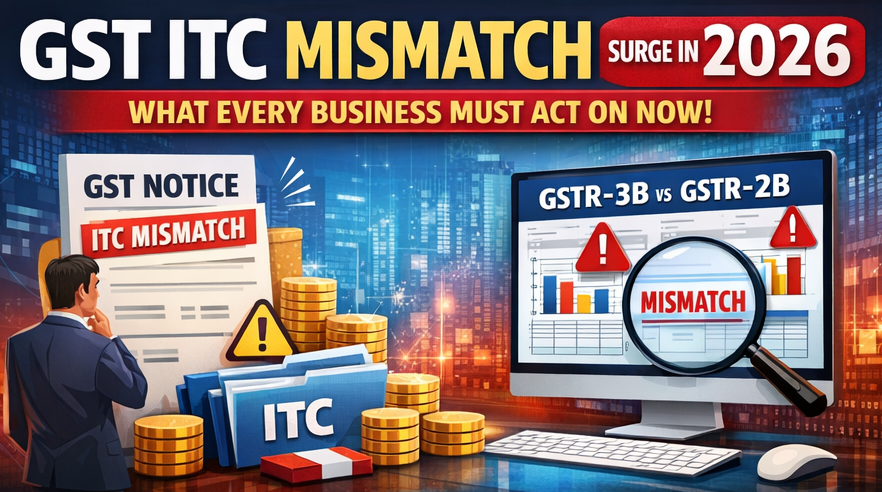
Why Many Businesses Are Receiving GST Notices in 2026
Over the past few months, there has been a noticeable surge in GST notices issued to businesses across sectors. The most common reason is a mismatch between Input Tax Credit (ITC) claimed in GSTR-3B and the details reflected in GSTR-2B. This is currently one of the most actively monitored areas by the GST department in 2026.
In simple terms, the government is now relying heavily on system-generated comparisons. If you claim tax credit in your return but the same does not appear in your auto-generated GSTR-2B (which is based on your supplier’s filings), the system automatically flags it. These mismatches are triggering notices under scrutiny and audit proceedings.
Many business owners assume that if they possess a proper tax invoice and have made payment to the supplier, their credit is safe. However, under the present compliance environment, the department is strictly insisting that ITC should reflect in GSTR-2B before it is claimed, unless very specific exceptions apply.
The important point to understand is this: This is not a technical audit exercise anymore. It is a fully automated, data-driven compliance check. Even small mismatches are getting picked up.
What Is Causing These Mismatches?
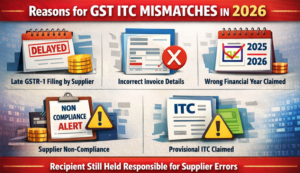
Based on current trends, the most common reasons are:
- Suppliers not filing their GSTR-1 on time.
- Suppliers filing returns but reporting invoices incorrectly.
- Incorrect GSTIN or invoice details entered while filing.
- ITC claimed in the wrong financial year.
- ITC taken provisionally without ensuring supplier compliance.
In many cases, the recipient business has done nothing wrong operationally. The issue arises because a supplier has defaulted or made reporting errors. However, under the GST framework, the responsibility of ensuring correct ITC ultimately falls on the recipient.
The department’s approach in 2026 has become more structured. Notices are being issued with detailed invoice-wise comparisons, asking businesses to either:
- Reverse the ITC with interest, or
- Provide documentary justification and reconciliation.
What is critical here is that interest liability is being calculated from the date of claim until reversal.
This has significant cash flow implications.
 Practical Steps You Should Take Immediately
Given the current environment, passive compliance is no longer sufficient. Businesses must adopt a proactive ITC control mechanism.
- Monthly 2B vs Purchase Register Reconciliation
Reconciliation should not be left until year-end. It must be done monthly. Any invoice not appearing in 2B should be immediately flagged and followed up with the supplier.
- Vendor Compliance Monitoring
Your vendor selection process must now include GST compliance behavior. Suppliers who repeatedly delay filing returns create financial risk for you. Consider maintaining a vendor compliance tracker.
- Avoid Provisional ITC Practices
The earlier practice of claiming credit first and reconciling later is no longer advisable. The department’s system-driven scrutiny makes this approach risky.
- Maintain Strong Documentation
In cases where ITC is legitimately claimable but disputed, you must have:
Tax invoice
• Proof of receipt of goods/services
• Proof of payment
• Communication with supplier
• Reconciliation working - Without documentation, defending ITC becomes difficult.
- Respond to Notices Strategically
If you receive a notice, do not rush to reverse credit immediately without analysis. Some mismatches are explainable, such as timing differences or amended returns. A structured reply supported by reconciliation statements often resolves the matter.
Final Thoughts
The GST framework in 2026 is increasingly technology-driven and compliance-focused. The era of broad-based audits is slowly being replaced by precision scrutiny based on data analytics.
For business owners, this means one clear thing:
Input Tax Credit management is no longer a routine accounting task. It is a financial control function that directly affects profitability and working capital.
A well-managed ITC process ensures:
• Better cash flow
• Reduced interest exposure
• Lower litigation risk
• Stronger vendor discipline
If your business has not yet conducted a detailed ITC health check for FY 2025-26, this is the right time to do so before notices escalate into formal proceedings.