
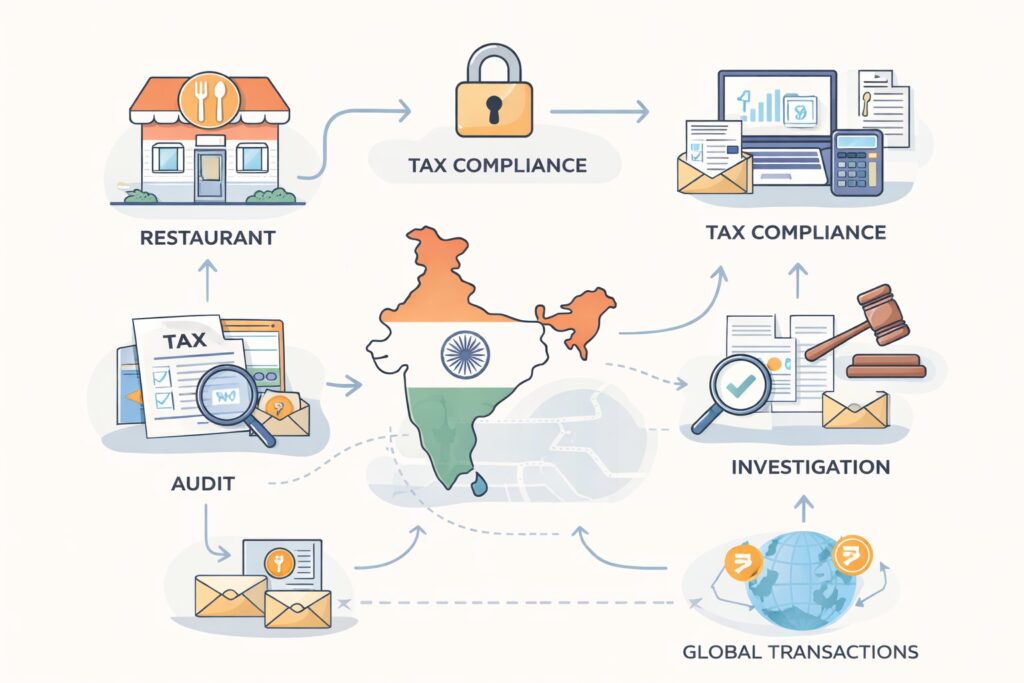
Government notifies new Income Tax Rules 2026 for stricter compliance
The government has notified the Income Tax Rules, 2026, which will come into effect from the 1st of next month. The new rules aim to enhance compliance through stricter disclosures while simplifying tax procedures by reducing the number of rules.
The rules mark a major overhaul of procedural and tax compliance systems under direct taxation. The Ministry of Finance has informed that the rules implement provisions of the Income-tax Act, 2025, replacing older procedural systems and incorporating updated definitions, compliance structures, and new reporting mechanisms. It stated that under the new rules, companies will have to maintain share registers, hold general meetings, and pay dividends only within India. This will imply stronger domestic control over dividend distribution.
The Ministry added that the Income Tax Rules, 2026, have also strengthened stock exchange compliances. Stock exchanges will now be required to maintain audit trails for seven years, prevent deletion of transaction records, and submit monthly reports on modified transactions to improve transparency and data integrity.
The new rules have also granted additional powers to India’s tax authorities for cross-border taxation. For non-resident income attrition, tax authorities can estimate income using a percentage basis, global profit ratios, or any other reasonable method.
The Income Tax Rules, 2026, have introduced clear guidelines for complex cases such as debenture conversions, income disclosure schemes for assets, and cross-border restructuring. A zero-coupon bond framework has been introduced to enhance regulatory oversight. The new approval system requires applications 3 months before issuance, investment-grade ratings from two agencies and defined fund usage timelines.
The Ministry further stated that for employer-provided accommodation, exemptions will now be determined based on criteria such as city population, salary level, and ownership or lease status.
The Income Tax Rules, 2026, aim to enhance transparency, digitisation, and standardisation across the taxation system. The framework focuses on strengthening data reporting mechanisms, bringing greater clarity to cross-border taxation, and improving regulatory structures. These measures are expected to reduce disputes and strengthen enforcement.
Income tax Department carries out nation-wide verification exercise on Restaurants suppressing turnover
Income tax Department carried out investigation relating to tax evasion pattern in Food & Beverage sector in November 2025. During the exercise, it was found that several restaurants were engaged in deletion of bulk bills and other modifications to suppress the actual sales.
Advanced analytics of transactional data from about 1.77 lakh restaurants in the F&B sector was carried out using AI-enabled analytical tools. The data was compared with the turnover declared in their Income Tax Returns. The analysis revealed largescale under-reporting of income. In some cases, recorded sales were not fully reflected in financial accounts or tax filings, and certain transactions were excluded from reported sales.
Consequently, on 8 March 2026, a nationwide survey was conducted on 62 restaurants across 46 cities in 22 States. On a preliminary basis, the exercise revealed suppression of sales amounting to around Rs. 408 Crores. Investigations in this regard are underway.
The Department continues to emphasise voluntary compliance and a trust-based approach. It has commenced the SAKSHAM NUDGE campaign to guide and advise taxpayers to correct their mistakes. Taxpayers are encouraged to file updated returns under Section 139(8A) of the Income Tax Act. In the first phase, emails and messages will be sent to the identified 63,000 restaurants, requesting them to update their returns before 31 March 2026.
Case Update: ITAT Mumbai on Black Money Act Penalty (March 2026)
Background of the Case
The Mumbai Bench of the Income Tax Appellate Tribunal delivered an important ruling clarifying the scope of penalty under Section 43 of the Black Money (Undisclosed Foreign Income and Assets) Act, 2015. The decision emphasizes that penalty cannot be levied mechanically for mere non-reporting in Schedule FA when the foreign asset is otherwise disclosed in the return of income.
Facts of the Case:
- The assessee, a company, had made an investment in a foreign entity (FM Overseas FZC, UAE) during the relevant assessment years.
- The said investment was duly recorded in the audited financial statements under “Non-current Investments” and disclosed in the balance sheet forming part of the income tax return.
- However, the assessee failed to report the foreign investment in Schedule FA of the return and also marked “No” against the foreign asset disclosure in Part B-TTI.
- The Assessing Officer initiated penalty proceedings under Section 43 and levied a penalty of ₹10 lakh per year, treating the omission as failure to furnish information relating to a foreign asset.
- The CIT(A) deleted the penalty, holding that the omission was a bona fide and technical lapse since the investment was already disclosed in the financial statements.
Judgment:
- The Tribunal held that Section 43 is triggered only when there is a failure to furnish any information in the return of income regarding a foreign asset. Mere non-disclosure in a specific schedule does not automatically satisfy this condition.
- In the present case, the foreign investment was disclosed in the audited balance sheet and reflected in Part A-BS of the return. Therefore, the return was not devoid of information relating to the foreign asset.
- The Tribunal observed that non-reporting in Schedule FA, despite disclosure elsewhere, constitutes a procedural or technical lapse, and not a case of complete non-disclosure.
- It was further held that penal provisions must be strictly construed, and the statutory trigger cannot be expanded to cover cases of mere incorrect placement or format of disclosure.
- The Tribunal also rejected the Revenue’s reliance on CBDT circulars, holding that administrative guidance cannot override or expand the scope of the statute.

Conclusion:
In the absence of complete failure to disclose the foreign asset in the return of income, the Tribunal held that penalty under Section 43 was not sustainable. The omission to report in Schedule FA was treated as a technical and inadvertent error, and the penalty of ₹10 lakh per year was accordingly deleted.
This ruling reinforces that penalty under the Black Money Act cannot be imposed mechanically for reporting lapses and that substantive disclosure in the return must be distinguished from procedural non-compliance.
Summary: Bombay High Court Judgment — WP(L) No. 7587 of 2026
Court: High Court of Judicature at Bombay Bench: Justice B.P. Colabawalla & Justice Firdosh P. Pooniwalla Date: March 9, 2026
Background
The case involved charitable trusts registered under the Maharashtra Public Trusts Act, 1950, along with professional bodies, which had long-standing income-tax registrations under Sections 12A/12AA of the Income-tax Act, 1961. Upon transitioning to the new regime under Section 12AB, they applied for renewal of registration. The Commissioner of Income Tax (Exemptions) rejected these applications, leading to the present challenge.
Two Grounds for Rejection
First Ground:
The Commissioner held that the trust deeds did not expressly state that the trusts were “irrevocable” and also lacked a dissolution clause. This absence was interpreted as rendering the trusts potentially revocable, thereby making them ineligible for registration under Section 12AB.
Second Ground:
In Form 10AB, Row 6 requires confirmation on whether the trust is irrevocable. However, the online portal forced applicants to select “Yes,” as choosing “No” prevented submission. Despite this technical compulsion, the Commissioner treated the response as “false information” and classified it as a “specified violation” under Section 12AB(4), using it as an additional ground for rejection.
Court’s Analysis and Findings
The Court rejected both grounds. It held that Section 12AB does not require an explicit irrevocability clause or dissolution provision. The statutory inquiry is confined to examining the objects of the trust, genuineness of its activities, and legal compliance. The Commissioner’s insistence on such clauses amounted to reading unwarranted conditions into the law.
Interpreting Section 63, the Court clarified that a “revocable transfer” exists only where there is an explicit provision for re-transfer of assets or reassumption of control by the settlor. In the absence of such provisions, a trust is inherently irrevocable. Therefore, silence in the trust deed implies irrevocability, contrary to the Commissioner’s view.
The Court also relied on the Maharashtra Public Trusts Act, noting that even upon revocation, trust assets cannot revert to the settlor but must be transferred to the Public Trusts Administration Fund or applied to similar charitable purposes under the cy-pres doctrine. This statutory safeguard eliminates concerns about misuse.
On the second ground, the Court held that penalizing applicants for a defect in the Department’s own portal is arbitrary. The trusts’ declaration of irrevocability was factually correct and made in good faith, and thus could not be treated as false information.
Orders Passed
The Court allowed the petition, quashed all rejection orders (including those under Section 80G), and directed fresh consideration of applications within six weeks from April 1, 2026. It also ordered modification of Form 10AB to ask whether a trust is “revocable,” thereby aligning the process with the correct legal position.
– With increasing scrutiny and evolving regulations, staying compliant is critical. Stay ahead with expert-led tax compliance India and avoid costly surprises.