
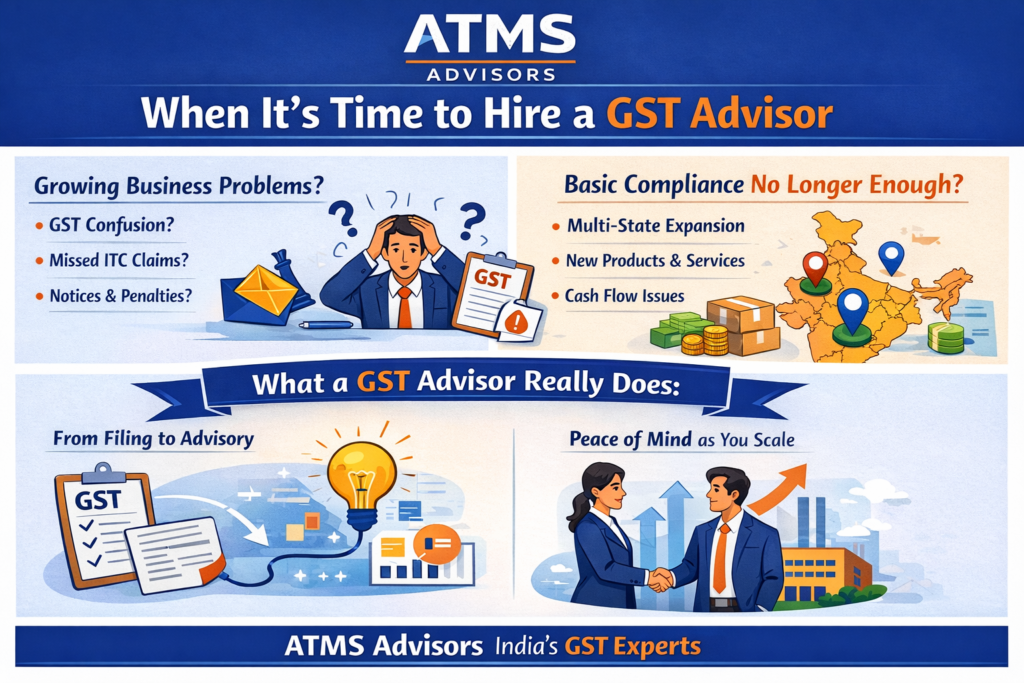
Most business owners don’t start with a GST advisor. They start with a CA, a basic accounting setup, maybe some software, and the belief that compliance can be “managed.” And in the early days, that usually works.
Returns get filed. Taxes get paid. Things seem under control.
Until they aren’t.
The shift from “manageable” to “messy” doesn’t happen overnight. It happens slowly, as the business grows, transactions increase, and GST starts showing up in places you didn’t expect.
That’s usually the point where founders start asking:
Do I need more than just filing support?
Do I need a GST advisor?
Lets understand,
What Does a GST Advisor Actually Do?
This is where most confusion starts. A lot of people assume a GST advisor is just someone who files GST returns more carefully. That’s not really the role.
Filing is execution.
Advisory is about decisions.
A GST advisor India looks at how GST affects your business before things happen — pricing, contracts, vendor structures, expansion into new states, even how you bundle your services.
It’s less about compliance.
More about avoiding future problems.
When Doing It Yourself (or Basic Support) Still Works
To be fair, not every business needs advisory from day one. If your setup is simple, you can manage with basic compliance support.
For example:
- You operate in one state
- You have a limited number of transactions
- Your product or service is clearly classified
- You’re not dealing with complex vendor chains
In these cases, a good accountant and disciplined bookkeeping go a long way.
The problem starts when the business stops being simple, but the compliance approach doesn’t evolve with it.
Signs It’s Time to Bring in a GST Advisor
Let’s make this practical.
These are the situations where founders usually realise they’ve outgrown DIY compliance.
- You’re Growing, but Your GST Setup Isn’t
Revenue is increasing.
Orders are coming in.
Maybe you’ve expanded to another state or started selling through new channels.
But internally, GST is still being handled the same way it was when you were smaller.
This gap is where mistakes begin.
At this stage, a GST advisor helps you realign systems before issues show up as notices or penalties.
- You’re Unsure About GST on New Offerings
You launch a new product. Or bundle services differently. Or change pricing.
And suddenly the question comes up, what GST rate applies here?
Most businesses either:
- Copy what competitors are doing, or
- Continue using old classifications
Both approaches carry risk.
A GST advisor helps you get clarity before you start billing, not after.
- Input Tax Credit Is Becoming Confusing
If you’ve ever looked at your GSTR-2B and thought, “this doesn’t match what we expected,” you’re not alone.
As vendor networks grow, ITC tracking gets messy.
Suppliers delay filings. Data mismatches increase. Credits get blocked.
At this point, it’s not just a compliance issue, it starts affecting cash flow.
This is where tax advisory services in India add real value. Not just by fixing issues, but by setting up processes so they don’t repeat every month.
- You’ve Started Receiving Notices
This is usually the turning point.
The first notice often feels small. A mismatch. A clarification request.
Many businesses respond casually.
But notices rarely exist in isolation. They usually point to a pattern.
If you’ve started receiving notices, even minor ones, it’s a good time to step back and review your GST structure properly.
- You’re Expanding Across States
Multi-state operations change the game.
Suddenly you’re dealing with:
- Multiple registrations
- Interstate transactions
- Place of supply complexities
- E-way bill coordination
What worked in a single-state setup starts breaking down.
At this stage, having a GST advisor in India is less about compliance and more about keeping operations smooth.
- GST Is Starting to Affect Business Decisions
This is the clearest signal.
When GST starts influencing:
- Pricing
- Vendor selection
- Contract terms
- Cash flow timing
…it’s no longer just a back-office activity.
It becomes part of business strategy.
And strategy needs advisory.
The Cost of Waiting Too Long Before Having a GST advisor on Board
Most founders don’t delay advisory because they don’t see value. They delay because things “haven’t gone wrong yet.”
But GST doesn’t always fail immediately.
Issues build up quietly.
- Incorrect ITC claims
- Classification errors
- Mismatched filings
- Delayed registrations
And when they surface, they rarely come one at a time.
By then, you’re not just fixing one problem. You’re untangling months of decisions.
That’s where costs increase, financially and mentally.
What Changes When You Work with a GST Advisor?
The biggest shift is not in filing.
It’s in confidence.
You stop second-guessing:
- “Is this rate correct?”
- “Can we claim this credit?”
- “Will this structure create issues later?”
Instead, decisions become clearer.
You start planning with GST in mind, rather than adjusting after the fact.
That’s the difference between compliance and advisory.
Where ATMS Advisors Fits In
At ATMS Advisors, we usually come in when businesses hit this transition point.
Not when everything is broken.
But when things are starting to feel unclear.
Our role is not just to manage compliance.
It’s to simplify it.
- Reviewing your current GST setup
- Identifying gaps before they turn into issues
- Helping structure transactions correctly
- Ensuring ITC and reporting stay aligned
In short, making GST one less thing you have to worry about while scaling your business.
A Simple Way to Think About It
If GST feels like a checklist filing, payment, deadlines you’re still in the compliance stage.
If GST is starting to influence decisions, margins, or growth you’ve entered the advisory stage.
And that’s usually the right time to bring in support.
Closing Thought
You don’t hire a GST advisor because you can’t file returns. You hire one because your business has reached a point where small mistakes carry bigger consequences.
Most founders wait until something goes wrong. The better time is just before that.
Frequently Asked Questions About GST Advisors in India
1. Do I really need a GST advisor if my returns are already being filed?
Filing ensures compliance, but it doesn’t prevent future GST issues.
A GST advisor helps you make the right decisions before problems arise.
2. When should a business consider hiring a GST advisor?
When your business starts growing, expanding, or facing GST confusion.
That’s usually when compliance alone is no longer enough.
3. How is a GST advisor different from an accountant or CA?
An accountant focuses on filing and reporting past data.
A GST advisor focuses on structuring decisions to avoid future risks.
4. Can a GST advisor help improve cash flow?
Yes, especially by optimizing Input Tax Credit and reducing mismatches.
Better GST planning directly impacts working capital efficiency.
5. What are the risks of delaying GST advisory support?
Small errors can build up into notices, penalties, and cash flow issues.
Fixing them later is always more complex and costly.