
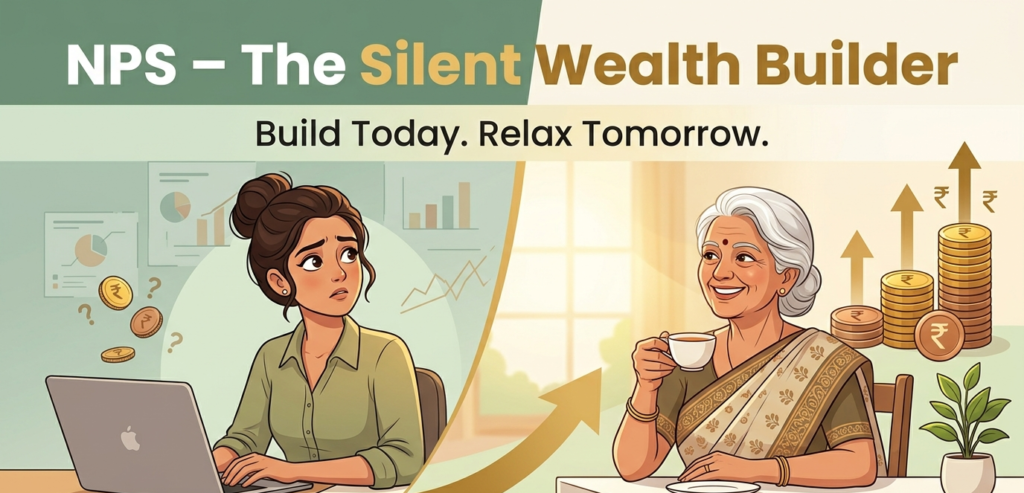
Let me paint you a picture.
It is a Tuesday morning. You are 60 years old. Your last salary came in three months ago and for the first time in your adult life, there is no more coming. The EMIs are done. The children are settled. But now there is a new question sitting quietly at the breakfast table: will what you have actually last?
For most Indians, that question arrives without a good answer. Not because they did not work hard. Not because they did not earn well. But because nobody told them, back when it would have mattered most, about a government-backed tool that was quietly compounding their future one month at a time.
That tool is the National Pension System NPS. And if you have not started yet, this article is for you.
What Exactly Is NPS, And Why Should You Care?
NPS, or the National Pension System, is a government-regulated, market-linked retirement savings scheme open to all Indian citizens between the ages of 18 and 70. It was originally created for government employees but has since been opened to everyone salaried professionals, self-employed individuals, and business owners alike.
Think of it as a retirement planning tool that works like a disciplined, long-term SIP except with far better tax benefits, government supervised, and the power of compounding working silently in the background for decades.
You contribute regularly. The money gets invested across equity, corporate bonds, and government securities based on a mix you choose. It grows. And when you retire, you have a corpus that can fund the life you actually want to live.
Simple. Structured. And remarkably powerful when started early.
NPS does not make noise. It does not trend on social media. It just works quietly, consistently, for decades. That is exactly what makes it special.
If NPS Is So Good, Why Does Almost Nobody Talk About It?
Fair question. And the answer says more about human psychology than it does about the product.
We are wired for instant gratification. We notice things that move fast, give quick returns, generate excitement. NPS does none of those things. It is the financial equivalent of planting a tree slow, quiet, and enormously rewarding over time. But we live in a world that celebrates the fireworks, not the roots.
Here is what actually happens emotionally when people hear about NPS:
- They hear lock-in till age 60 and feel trapped even though every rupee is working hard for them in the meantime.
- They hear government scheme and assume it is boring or low-return without looking at the actual numbers.
- They see no immediate reward and lose interest even though the reward at the end is life-changing.
- They think I will start later and later quietly becomes never.
This is not a criticism. It is just how we are built. But understanding this emotional pattern is the first step to breaking it.

How NPS Actually Works in Plain Language
Here is a straightforward breakdown, without the financial jargon:
1. Two Types of Accounts
NPS gives you two accounts. Tier I is the primary retirement account your contributions here are locked in till age 60 but come with the best tax benefits. Tier II is a voluntary account with no lock-in you can withdraw anytime, but the tax benefits are limited. Most people focus on Tier I, and for good reason.
2. You Choose Your Investment Mix
NPS lets you decide how your money is invested. You can go Active Choice where you manually set how much goes into equity (up to 75%), corporate bonds, and government securities. Or you can go Auto Choice where the system automatically shifts your portfolio from aggressive to conservative as you age. For beginners, Auto Choice is often the smarter starting point.
3. Who Manages Your Money?
Your NPS funds are managed by PFRDA-regulated pension fund managers professional institutions like SBI Pension Funds, HDFC Pension, ICICI Prudential Pension, and others. You choose your fund manager. They are regulated, transparent, and accountable.
4. What Happens at Retirement?
At age 60, you can withdraw 60% of your total corpus as a lump sum completely tax-free. The remaining 40% is used to buy an annuity, which gives you a regular monthly income for the rest of your life. That combination of a tax-free lump sum and a guaranteed monthly pension is something very few other instruments offer.
The Emotional Side of NPS Why We Avoid What’s Good for Us
Let’s be honest about something.
Most people who read about NPS think: this sounds sensible. And then they close the tab and do nothing. Not because they disagree but because of a few deeply human emotional patterns that get in the way of every good long-term decision.
The Lock-In Feels Like a Trap
Our brains do not like to give up control. Knowing that your money is locked away until 60 can feel suffocating even if rationally, that structure is exactly what protects you from spending it on the wrong things. The lock-in is not a cage. It is an armour.
Retirement Feels Too Far Away
When you are 27, age 60 is 33 years away. It does not feel real. So the urgency to plan for it does not feel real either. But compound interest does not care about your sense of urgency. It starts working the moment you do and stops the moment you delay.
We Prefer Visible Wins
A mutual fund you can check daily feels active and exciting. NPS, quietly compounding in the background, feels invisible. But the best financial decisions are often the boring ones the ones you set up and forget, and then one day look at and feel deeply grateful for.
We Trust What We Know
FDs feel safe because we grew up watching our parents use them. Gold feels secure because it has always been there. NPS is newer, less familiar, and therefore feels risky even though it is government-regulated and professionally managed. Familiarity is not the same as safety. And unfamiliarity is not the same as risk.
Every month you delay starting NPS is a month of compounding you can never get back. The best time was yesterday. The second-best time is today.
Is NPS Right for You? A Quick Self-Check
NPS works best for people who:
- Are between 25 and 45 years old and want to build a retirement corpus systematically
- Want a low-cost, government-regulated, professionally managed long-term investment
- Are comfortable with a lock-in until age 60 in exchange for significantly higher long-term returns
- Do not yet have a dedicated retirement savings plan and want to start one today
NPS may not be the only thing you need but for most beginners, it is an essential piece of a complete wealth management strategy. Think of it as the foundation on which everything else is built.
A Final Word from One Honest Voice to Another
Nobody gets excited about retirement planning at 28. Nobody jumps out of bed thinking about pension funds. That is completely normal.
But here is what people who started early will tell you: the version of themselves at 60 is deeply grateful to the version at 28 who made one quiet, boring decision and stuck with it.
NPS will not make headlines. It will not give you a story to tell at a dinner party. It will not feel dramatic or exciting. But 30 years from now, when you are sitting at that breakfast table with options with freedom, with security, with a corpus that says you planned ahead you will understand exactly why the silent ones are often the most powerful.
If you want to understand how NPS fits into your full financial picture alongside mutual funds, insurance, tax planning, and your broader goals our wealth management services are built exactly for that. A conversation with our investment advisor costs you nothing but time. And it could change everything.
The loudest investments get the most attention. The quietest ones build the most wealth.
Start NPS today. Your future self will thank you.
Quietly. Consistently. Powerfully.