
Demat 2.0- SEBI & RBI
India’s financial market infrastructure took another leap forward as the Securities and Exchange Board of India (SEBI) and the Reserve Bank of India (RBI) jointly unveiled Demat 2.0. Announced at the Global Fintech Fest in Mumbai by RBI Governor Sanjay Malhotra and SEBI Chairman Tuhin Kanta Pandey, the pilot project introduces Distributed Ledger Technology (DLT) and central bank digital currency to modernise how corporate debt is issued, settled, and serviced.
DEMAT 2.0:
Demat 2.0 is a pilot being undertaken by SEBI to explore the next-generation financial market infrastructure. It tests the issuance, holding, trading and settlement of corporate bonds in tokenised form using Distributed Ledger Technology (DLT). The pilot is the next step in dematerialisation. Instead of recording ownership through a conventional database architecture, the corporate bond is issued as a native digital token on a private, permissioned DLT network owned by the Depositories. The token is the corporate bond. The pilot does not change the legal character, rights, obligations or regulatory treatment of the corporate bond. What changes is only the technology. Ownership recording, transfer of securities and settlement of the funds leg now take place on a Distributed Ledger Technology (DLT) platform.
What exactly is being tokenised?
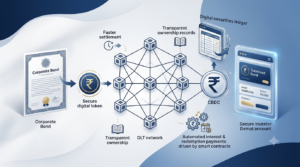
The corporate bond itself is issued as a digital token on DLT infrastructure. The token bears the same ISIN as the corresponding bond issue. The bond’s key terms – such as coupon rate, payment dates, day-count convention and redemption terms – are encoded into the token through a smart contract.
Issuance of Tokenised Bond
The issuer will continue to use the existing Electronic Bidding Platform (EBP) of stock exchanges for issuance. The ISIN is obtained from the depositories in the usual manner but is flagged as a pilot/tokenised ISIN. Bidding, bid modification, cancellation and allotment timelines remain as they are today. On allotment the depository credits the securities directly to the Demat 2.0 accounts (a Demat 2.0 account is an extension of the investor’s existing demat account and is not a separate demat account) of the allottees. Issue proceeds are received by the issuer in its CBDC wallet.
What changes, and what doesn’t?
| Aspect | Today’s process | Under Demat 2.0 |
| Funds to issuer after bidding | Generally, 2–3 days | Same day |
| Secondary market settlement | 2–3 days, with settlement risk in the interim | Immediate, atomic — settlement risk eliminated |
| Interest / redemption payment | Issuer/registrar obtains holder list from depositories, computes amounts, routes payment via banking channel | Smart contract auto-credits e₹ to each bondholder’s CBDC wallet on the due date |
| Investor account / KYC | Existing demat account | Same existing demat account; no fresh KYC — investor must enable Demat 2.0 and hold a CBDC wallet with a participating bank |
Demat 2.0 marks an important step towards modernising India’s securities market by using Distributed Ledger Technology (DLT) for corporate bonds. It aims to make securities ownership records, transfers and settlement more efficient, transparent and secure, while enabling faster settlement through integration with the wholesale Central Bank Digital Currency (CBDC).