
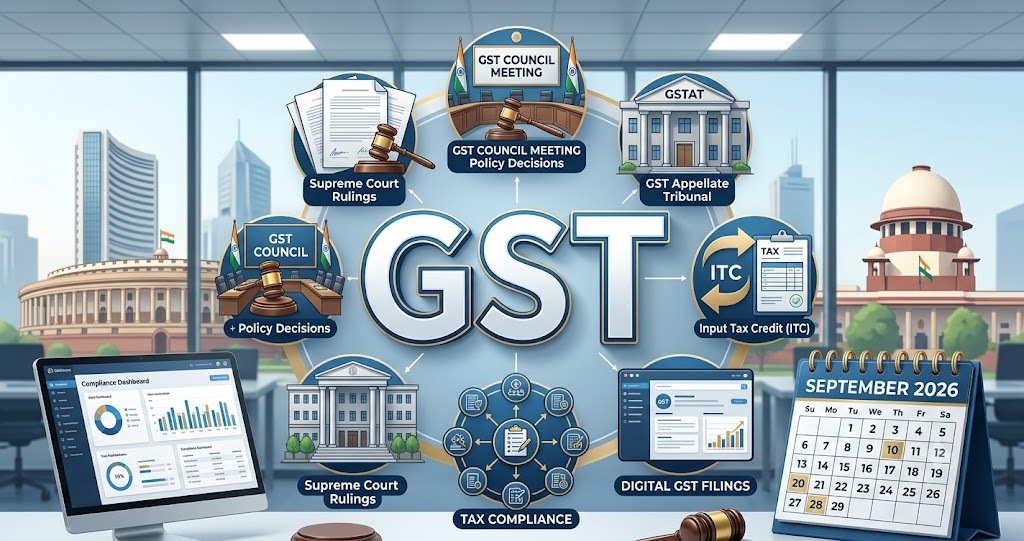
GST Updates September 2026
Dear Client, GST has been unusually busy over the last few weeks record tax collections, important Supreme Court and High Court rulings, a big Council meeting round the corner, and some return-filing changes that affect your monthly compliance. We have picked out everything that actually matters to a business owner and explained it in plain language, with no legal jargon. Here it is.
1. Big GST Council Meeting on 12th September — Here’s What May Change
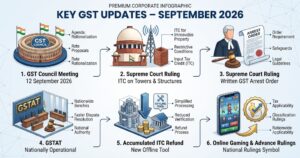
The GST Council the body headed by the Union Finance Minister and made up of the finance ministers of every state, which decides all GST rules and rates is meeting on 12th September 2026 in Delhi. An Officers’ Meeting, where senior tax officials from the Centre and states prepare the ground, will be held a day earlier on 11th September. This is the Council’s first full sitting in almost a year. Its last meeting, the 56th, was held on 3rd–4th September 2025 and delivered what is now widely called “GST 2.0” the move from four tax slabs to mainly two (5% and 18%), with a separate 40% rate kept for a short list of luxury and “sin” goods. Those changes took effect from 22nd September 2025, so this meeting lands almost exactly one year later, at a natural point to take stock of how the new structure has actually performed.
A lot has changed in that one year, which is part of why this meeting is being watched closely. The GST Appellate Tribunal (GSTAT), covered in more detail later in this newsletter, has gone from non-existent to operational with benches opening across the country. GST collections have also stayed strong through this transition August 2026 alone brought in nearly ₹2 lakh crore, 14.8% higher than a year earlier giving the Council a full year of real revenue data to examine rather than projections.
The Council’s decisions do not take effect on their own. Whatever is decided on 12th September still needs to be formally notified by the CBIC before it becomes binding law, and that process usually takes some days to weeks.
| What this means for you: We’ll let you know as soon as there is something concrete to act on. What matters for you right now is simply this: don’t change any GST position, filing approach, or pricing based on pre-meeting news reports. We will send a special update the moment the Council’s actual decisions and the CBIC notifications are out. |
2. Supreme Court: ITC Allowed on Towers, Structures Fixed to Land
The Supreme Court has finally closed a long-running dispute involving Bharti Airtel and other telecom companies. The department had argued that telecom towers being fixed to land or a rooftop are “immovable property” and therefore ITC (input tax credit) should be blocked on them under Section 17(5).
The Supreme Court disagreed and confirmed that such towers qualify as “plant and machinery” equipment used to run the business and are therefore NOT covered by the immovable property block. The department’s plea to get this decision reviewed was also dismissed on 19th August 2026, so the matter is now settled.
| What this means for you: If your business owns capital assets that are bolted or fixed to land or a building machinery, structural supports, plant foundations, towers, or similar equipment and you have not claimed ITC on them fearing an “immovable property” objection, this ruling strengthens your case. Speak to us before you decide whether to claim it, since the specific facts of each asset still matter. |
3. Supreme Court: No GST Arrest Without a Written, Communicated Order
In an important ruling protecting taxpayers’ rights, the Supreme Court has held that before GST officers can arrest a person under Section 69 of the CGST Act, the written order authorising that arrest must first be communicated (shared) with the person concerned.
In simple terms an officer can no longer arrest someone first and explain the paperwork later. The person must know, in writing, why and under what authority they are being arrested, before the arrest happens.
| What this means for you: This is a genuine safeguard for business owners and directors in search, summons, or investigation situations. If you or anyone in your business ever faces a GST investigation, remember that you are entitled to see the written arrest order before, not after, you are taken into custody. Please call us immediately if your business receives any summons or search notice early legal guidance matters a great deal in such situations. |
4. GST Tribunal (GSTAT) Is Now Up and Running Nationally
After nearly eight years of businesses having no proper second-level forum to appeal GST orders, the GST Appellate Tribunal (GSTAT) is now functioning. The Principal Bench in Delhi started hearing cases in February 2026, and State Benches (Kolkata, Chennai, Hyderabad, Agra, and others) have been opening in phases through the year. GST Updates September 2026.
- The one-time window to file old, backlogged appeals (for orders passed before 1st April 2026) closed on 30th June 2026.
- For any fresh order from the first appellate authority now, the normal rule applies: file your GSTAT appeal within 3 months of receiving the order.
- Filing needs a 20% pre-deposit of the disputed tax and is done online through Form APL-05.
| What this means for you: If you have any pending appeal or an order that was under the old ‘no tribunal available’ limbo, please check with our litigation team immediately on where it stands — some backlog deadlines have already passed, and missing a fresh 3-month window can shut the door on an otherwise good case. |
5. New Offline Tool for Accumulated ITC Refunds
GSTN has released a new Excel-based offline utility to prepare “Annexure-B” the statement required while filing a refund claim for accumulated Input Tax Credit (typically relevant for exporters and businesses with an inverted duty structure, such as many manufacturers and textile units).
| What this means for you: If you regularly file accumulated-ITC refund claims, this tool should make the paperwork noticeably less painful and reduce errors that currently cause refund rejections or delays. We can help you set this up for your next filing cycle. |
6. Supreme Court Settles the Online Gaming GST Debate
In a landmark ruling, the Supreme Court has held that GST applies to online gaming, fantasy sports, and casino platforms wherever players stake real money on an uncertain outcome regardless of whether the game itself involves skill or chance. This overturns an earlier Karnataka High Court view that had gone in the platforms’ favour.
| What this means for you: This ruling itself does not affect most businesses, but if you or anyone you advise operates in online gaming, fantasy sports, or a similar stake-based platform, GST is payable on the full value staked by the player not merely the platform’s commission or fee. Please reach out for a specific review if this applies to you. |
7. Advance Rulings to Get More Consistent Across States
One long-standing headache under GST has been that businesses operating in multiple states could get completely different, even contradicting, Advance Rulings from different State Authorities on the very same question for example, how a product should be classified, or whether a particular activity counts as a ‘supply’ at all.
From April 2026, the Principal Bench of the GST Appellate Tribunal (GSTAT) has been designated as the National Appellate Authority for Advance Rulings (NAAAR). It can now issue a single, binding, nationwide ruling that overrides conflicting state-level rulings on the same question.
| What this means for you: If your business operates across multiple states and has ever run into conflicting Advance Rulings, or is considering seeking one, this is genuinely good news you may now be able to get one consistent, nationwide answer instead of navigating different positions state by state. Let us know if you would like to explore this route for any open classification or applicability question. |