

ITAT Mumbai Restores 12AB Registration & 80G Approval for Hinduja Hospital Trust: Income Tax Ruling
Case: National Health & Education Society v. CIT (Exemption) ITAT Mumbai ‘B’ Bench, August 3, 2026 [[2026] 189 taxmann.com 290]
Bench: Amit Shukla (Judicial Member) & Prabhash Shankar (Accountant Member)
The assessee-society, which has run the renowned P.D. Hinduja National Hospital and Medical Research Centre since 1954, had enjoyed uninterrupted charitable registration since 1974. When it applied for routine continuation of its 12AB registration and 80G approval after migrating to the new registration regime, the CIT(Exemption) instead rejected continuation, cancelled the existing registration retrospectively from 2021, and consequently rejected 80G approval too. The Tribunal comprehensively overturned this on every ground raised, restoring the hospital’s charitable status.
Foreign CME expenses aren’t “application of income outside India”
The CIT(E)’s primary objection was that the hospital reimbursed doctors for attending international medical conferences, workshops, and continuing medical education abroad treated as a violation of Section 11(1)(c). The Tribunal firmly rejected this reasoning, holding there is a fundamental difference between carrying on charitable activity outside India and merely incurring expenditure abroad in furtherance of a charitable purpose performed entirely in India. The doctors attended these programmes purely in a professional capacity, returned to treat patients in India, and no branch, centre, or charitable activity was ever established overseas. The Tribunal noted that modern tertiary healthcare demands constant global engagement new surgical techniques, oncology protocols, robotic procedures, and AI-assisted diagnostics all evolve through international collaboration and treating such academic expenditure as “charity outside India” would absurdly extend to equipment purchases, journal subscriptions, and foreign expert consultations too. Crucially, the CIT(E) never alleged the expenditure was personal, excessive, or unconnected to medical practice so the finding couldn’t stand.
IPF Scheme compliance is not the CIT(E)’s call to make
The second ground concerned alleged non-compliance with the Indigent Patients Fund (IPF) Scheme under Section 41AA of the Maharashtra Public Trusts Act. The Tribunal held this was a serious jurisdictional overreach implementation and monitoring of the IPF Scheme falls exclusively within the domain of authorities under the MPT Act and the Monitoring Committee constituted by the Bombay High Court, not the Income-tax Department. Absent any conclusive finding of breach by that competent regulator, the CIT(E) had no business independently adjudicating the issue. On facts too, the finding collapsed: the hospital had submitted month-wise beneficiary summaries, acknowledgements of statutory filings, Monitoring Committee inspection reports, specimen patient records, and had explicitly offered to produce any further original records on request an offer the CIT(E) never took up. The Tribunal also noted the hospital’s charity extended well beyond statutory minimums through its own Medical Social Work Department, a fact the impugned order largely ignored.
Charging market rates and running a surplus ≠ commercial motive
The most substantial ground was the CIT(E)’s conclusion that high tariffs, premium infrastructure, and consistent operational surplus meant the hospital was functioning as a commercial enterprise. The Tribunal decisively rejected this, holding that the Act imposes no requirement that charitable hospitals operate on a “no-surplus” basis or treat every patient free of cost. It explained the economics of modern tertiary care ICUs, transplant units, robotic surgery systems, research labs require enormous investment that can only be sustained through a cross-subsidisation model, where paying patients fund free and concessional treatment for the indigent. Crucially, Parliament deliberately chose not to extend the commerciality restrictions applicable to “general public utility” institutions (under the Section 2(15) provisos) to institutions engaged in medical relief a conscious legislative choice the CIT(E) ignored. With no finding that surplus was ever diverted to trustees or specified persons, and clear evidence it was reinvested into facilities, education, and research, the commercial-motive theory failed.
No evidence of abandoned charitable objects = no retrospective cancellation
The Tribunal drew a sharp line between registration proceedings (which test institutional identity and genuineness) and assessment proceedings (which test year-specific application of income). It held that debatable interpretations of Section 11(1)(c), disputed compliance under a different statute, or disagreements over financial models can never, by themselves, justify the drastic and far-reaching step of retrospectively extinguishing a charitable institution’s registration especially one with over five decades of unbroken recognition. Retrospective cancellation, the Tribunal stressed, doesn’t just affect the current year but destabilizes exemption claims, donor confidence, and completed assessments for years the institution had legitimately relied on its registration.
80G approval falls automatically once 12AB stands restored
Since the 80G rejection was entirely consequential resting on no independent violation of Section 80G’s own conditions it could not survive once the underlying 12AB cancellation was set aside.
Bottom line: Both appeals ITA No. 4201/Mum/2026 (12AB cancellation) and ITA No. 4200/Mum/2026 (80G rejection) were allowed in full favour of the assessee. The Tribunal expressly followed and applied the governing principles laid down in its earlier ruling in Reliance Foundation Hospital Trust v. CIT (Exemptions) [2026] 187 taxmann.com 570, reinforcing a consistent judicial approach protecting charitable hospitals from having routine registration renewals turned into backdoor assessment proceedings.
ITAT Chennai: Enhanced Rs. 25 Lakh Leave Encashment Exemption Applies Retrospectively to A.Y. 2020-21:
Case: Gopalakrishnan Sriram v. Income-tax Officer ITAT Chennai Bench ‘B’, August 5, 2026 [[2026] 189 taxmann.com 393]
Bench: Manu Kumar Giri (Judicial Member) & S.R. Raghunatha (Accountant Member)
The assessee, a retired employee of Indian Bank, received leave encashment of Rs. 12,27,232 upon superannuation in FY 2019-20 (relevant to A.Y. 2020-21). While the CPC allowed exemption only up to Rs. 3,00,000 the ceiling fixed under the old 2002 notification the assessee later claimed the benefit of the sharply enhanced Rs. 25,00,000 limit introduced by CBDT Notification No. 31/2023. The CIT(A) rejected this, holding the enhanced notification applied only from 01.04.2023 onward. The Tribunal reversed this and ruled entirely in the assessee’s favour in income tax ruling
A two-decade-old ceiling finally catches up with reality
Section 10(10AA)(ii) exempts leave encashment for non-government employees, subject to a government-notified ceiling one that had remained frozen at Rs. 3,00,000 since 2002 despite dramatic increases in salary structures over the following twenty years. The Tribunal noted this stagnation had already drawn judicial scrutiny, including a Delhi High Court observation (Kamal Kumar Kalia v. Union of India) flagging the unfairness of the unchanged limit. Notification No. 31/2023 finally corrected this by raising the ceiling to Rs. 25,00,000 aligning non-government employees with the treatment given to government staff.
A “rationalizing” measure, not a fresh concession
The Tribunal held that this enhancement wasn’t the creation of a new benefit but a long-overdue rationalization of an existing exemption to reflect current economic conditions. Since the amendment’s core purpose was to mitigate hardship and remove disparity between government and non-government retirees, it fell squarely within the category of beneficial and curative legislation the kind courts have consistently held should be construed liberally and, where appropriate, given retrospective effect.
No express retrospective clause? Doesn’t matter.
The Tribunal rejected the Revenue’s argument that the notification only took effect from 01.04.2023. It reasoned that the absence of an explicit retrospective clause is not decisive when an amendment merely enlarges an existing benefit rather than creating a fresh liability. Tellingly, the notification’s own Explanatory Memorandum expressly certified that “no person is being adversely affected” by giving it retrospective effect reinforcing that applying it to earlier years harms no vested right of the Revenue.
Denying parity would create an arbitrary cut-off among retirees
The Tribunal found real force in the argument that refusing the enhanced exemption to those who retired before the notification date while allowing it to those retiring after would create an unjust and artificial distinction between similarly placed employees, defeating the very purpose of the amendment and offending basic principles of equity in tax law.
Backed by a wave of consistent coordinate bench rulings
The Tribunal’s decision aligns with a long, growing line of similar rulings across Jaipur, Chandigarh, Ahmedabad, Delhi, Agra, Pune, and Chennai benches over 20 cited precedents including Ram Dev Daiya (Jaipur) and Govardhan Deepchand Bhambhani v. ITO (Ahmedabad), all holding that the Rs. 25 lakh limit applies retrospectively regardless of the employee’s actual retirement year.
Bottom line: Since the entire leave encashment amount of Rs. 12,27,232 fell within the enhanced Rs. 25,00,000 ceiling, the Tribunal directed the Assessing Officer to allow full exemption, setting aside both the CPC’s restriction and the CIT(A)’s confirmation of it. Appeal allowed in favour of the assessee.
ITAT Mumbai: Faceless Reassessment Conducted Before Section 151A Scheme Notification is Void Ab Initio:
Case: Le Meilleur Global Trade (P.) Ltd. v. ITO ITAT Mumbai Bench ‘A’, August 4, 2026 [[2026] 189 taxmann.com 286]
Bench: Pawan Singh (Judicial Member) & Girish Agrawal (Accountant Member)
The assessee had filed its return for A.Y. 2013-14 declaring minimal income. Based on information from the Investigation Wing alleging an undisclosed penny-stock sale of over Rs. 1.56 crore, the case was reopened under Section 147 via notice under Section 148 dated 31.03.2021. The National Faceless Assessment Centre (NFAC) then conducted the entire reassessment issuing notices under Sections 142(1), 144B(1)(xi), and a show-cause under Section 144 culminating in a reassessment order dated 31.03.2022. The assessee challenged the very jurisdiction of NFAC to have conducted these faceless proceedings, and the Tribunal agreed, allowing the appeal purely on this jurisdictional ground.
A scheme can’t apply before it exists
Section 151A empowers the Central Government to notify a scheme enabling faceless reassessment under Section 147 and faceless issuance of notice under Section 148. While the section itself was inserted into the statute with effect from 01.11.2020, the Tribunal emphasized a crucial distinction: the section merely being on the books is not the same as the scheme being operative. The actual scheme the “e-Assessment of Income Escaping Assessment Scheme, 2022” was notified in the Official Gazette only on 29.03.2022. Until that notification was published, NFAC had no legal authority to conduct faceless reassessment proceedings at all.
Timeline told the whole story
The Tribunal carefully mapped every procedural step against the notification date and found nearly the entire reassessment process notices under Section 142(1) dated 10.11.2021, 30.12.2021, and 31.01.2022; the Section 144B(1)(xi) show-cause dated 17.02.2022; and the Section 144 show-cause dated 25.02.2022 occurred before 29.03.2022. Only the final reassessment order itself, dated 31.03.2022, came after the notification. That timing gap proved fatal: jurisdiction was assumed and exercised by NFAC at a point when the enabling scheme simply didn’t yet exist in law.
Distinguishing Section 151A from the older faceless assessment framework
The Tribunal drew a useful contrast with Section 143(3A)–(3C), under which the original “E-Assessment Scheme, 2019” was notified back in September 2019 for regular assessments. That comparison reinforced that each faceless scheme requires its own independent gazette notification to become operative an earlier, unrelated notification for a different provision cannot be borrowed to validate action taken under Section 151A before its own scheme was published.
A defect that goes to the root of jurisdiction
Since assumption of jurisdiction by NFAC prior to the notification date was held to be “without the authority of law,” the Tribunal declared the entire faceless reassessment proceeding and the resultant order void ab initio and non est. This finding rendered every other ground of appeal (validity of the Section 148 notice, additions under Section 68 on the alleged penny-stock transaction, etc.) purely academic, since a void proceeding cannot give rise to a sustainable order regardless of its merits.
Backed by coordinate bench precedent
The Tribunal relied on and followed the Kolkata Bench’s ruling in Nabiul Industrial Metal (P.) Ltd. v. ITO [IT Appeal No. 1328 (Kol) of 2004, dated 15.10.2024], which had addressed an identical timing issue and reached the same conclusion reassessment conducted by a faceless authority before the relevant scheme’s notification lacks jurisdictional validity.
Bottom line: The reassessment order under Section 147 read with Sections 143(3) and 144B was quashed as void ab initio for want of jurisdiction. Appeal allowed in favour of the assessee, with all merit-based grounds left unadjudicated as academic.
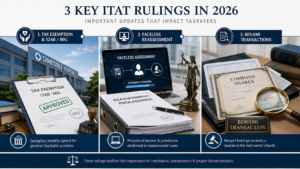
SAFEMA Tribunal Upholds Benami Attachment of RIL Shares Held by Shell Company; Orders Release of Wrongly Frozen Additional Shares:
Case: Om Parkash Agarwal v. Initiating Officer (DCIT/ACIT) Appellate Tribunal SAFEMA, New Delhi, July 30, 2026 [[2026] 189 taxmann.com 232]
Bench: Balesh Kumar & Rajesh Malhotra, Members
This ruling arises from two connected appeals FPA-PBPT-1481/Mum/2021 and FPA-PBPT-1482/Mum/2021 filed by Om Prakash Agarwal, a promoter of Responsive Industries Ltd. (RIL), and Rajput Plastics & Polymers Pvt. Ltd. (RPPL), against an order of the Adjudicating Authority confirming a Provisional Attachment Order under the Prohibition of Benami Property Transactions Act, 1988 (PBPTA). A connected Miscellaneous Petition sought release of additional shares that had also been swept into the freeze. The Tribunal dismissed the substantive appeals but granted partial relief on the ancillary petition.
Background: a company that appeared out of nowhere to buy crores worth of shares
RPPL was incorporated on 26.07.2017 with a paid-up capital of just Rs. 1 lakh, held equally by two directors Ajay Pratap Singh and Ashok Jha. Within roughly a year, in FY 2018-19, this barely-capitalised entity acquired 10.43 lakh shares of RIL from the open market. The Initiating Officer, acting on information gathered during a survey under Section 133A of the Income-tax Act at RPPL’s premises, formed the view that RPPL lacked any real financial or operational capacity to fund such an acquisition and that the shares were, in truth, being held for the benefit of Om Prakash Agarwal. A Show Cause Notice was issued, followed by provisional attachment on 31.10.2019, and a formal Provisional Attachment Order under Section 24(4)(a)(i) on 28.01.2020 later confirmed by the Adjudicating Authority on 27.09.2021.
Tracing the money: a closed loop of connected entities
The Tribunal’s central inquiry was simple but decisive did RPPL fund this purchase itself, or did Agarwal supply the money through intermediaries? The bank trail told the story. RPPL received close to Rs. 9 crore from Gouri Shankar Investments Pvt. Ltd. to fund the share purchase. Crucially, Gouri Shankar Investments was a group company of Kamal Kumar Jalan Securities the very stockbroker that had facilitated the RIL share purchase and had, undisputedly, been Om Prakash Agarwal’s own broker for years. Another entity in the same broker group, Priyasha Meven Finance, also featured in the transaction chain.
RPPL then repaid part of this loan using Rs. 2.42 crore received from Axiom Cordages Ltd. and Rs. 1.01 crore received directly from RIL both entities squarely within RIL’s own promoter group. The Adjudicating Authority’s order (extensively reproduced by the Tribunal) described this candidly as funds being “routed from the promoter group of RIL, on behalf of Shri Om Prakash Agarwal,” moving through broker-linked conduits designed to obscure the ultimate source.
Claims of genuine business dealings collapsed for lack of proof
The appellants argued these were legitimate commercial repayments that RPPL supplied raw material to RIL and had separately advanced Rs. 12.94 crore to Axiom Cordages, with the disputed sums merely representing repayment of outstanding trade balances. The Tribunal was unimpressed: no invoices, contracts, correspondence, or any documentary evidence whatsoever was produced to substantiate any actual supply relationship. Tellingly, RPPL’s own list of sale and purchase parties, submitted during proceedings, didn’t even include Gouri Shankar Investments nor had the Rs. 9 crore received from it been disclosed as a loan creditor in RPPL’s income tax returns or tax audit report.
A registered office that existed only on paper
Physical verification dealt a further blow to RPPL’s credibility. The company’s registered address had never housed any office, factory, or godown a fact confirmed independently by both the property’s landlord and its actual occupying tenant, Mithun Singh. Instead, RPPL was found operating from the same premises as RIL and Axiom Cordages Ltd. the very entities it claimed to be transacting with at arm’s length.
Directors who knew nothing about the company they ran
Perhaps the most striking evidence came from the directors themselves, recorded under oath:
- Ashok Jha stated he was Om Prakash Agarwal’s personal driver of over 20 years, earning Rs. 18,000 per month. He testified he had never even heard of RPPL, had no idea he held shares or a directorship in it, had received no benefits from it, and simply signed whatever documents Ajay Pratap Singh brought him, on Agarwal’s instructions, without knowing their contents.
- Ajay Pratap Singh described himself as a fitness trainer and spiritual yoga teacher, could not recall whether his own remuneration from RPPL came by cash or cheque, claimed to run all company operations over the phone (conveniently leaving no paper trail), and displayed no working knowledge of the business he supposedly directed. Notably, it was Agarwal who had introduced him for membership to The Bombay Presidency Radio Club evidencing personal closeness rather than commercial distance.
Applying the Supreme Court’s benami test
The Tribunal anchored its analysis in the Supreme Court’s guidance in Binapani Paul v. Pratima Ghosh (drawing on Valliammal v. Subramaniam), which lists six touchstones for identifying a benami transaction most importantly, the source of purchase money and the motive for disguising true ownership. The Tribunal acknowledged that benami intent is typically “shrouded in a thick veil which cannot be easily pierced through,” but held the circumstantial evidence here was overwhelming: two financially unremarkable individuals with no real stake, knowledge, or control were installed as the ostensible owners of a company holding shares worth crores, funded entirely through a web of promoter-linked entities.
Verdict: benami transaction established
The Tribunal concluded that RPPL was the benamidar and Om Prakash Agarwal was the beneficial owner, holding that he had structured an indirect acquisition through a company controlled via a driver and a yoga teacher who would never question his authority precisely to avoid directly purchasing the shares in his own name. The provisional attachment of the 10.43 lakh shares was confirmed, and both appeals were dismissed.
A separate battle: shares that were never even accused of being benami
Alongside the main appeals, the appellants pursued Miscellaneous Petition No. 4703 of 2023, raising an entirely different grievance. RPPL’s demat account actually held 21.52 lakh RIL shares in total but the Show Cause Notice, the Provisional Attachment Order, and the Adjudicating Authority’s order had all consistently and specifically referenced only 10.43 lakh shares as the alleged benami property. Despite this, the freeze communications sent to NSDL and CDSL had locked the entire demat account, effectively immobilising an extra 11.09 lakh shares that were never named, discussed, or attached in any proceeding hampering RPPL’s ordinary business operations in the process.
Tribunal finds the over-freeze unjustified
Reviewing the Provisional Attachment Order, the confirming order, and the original Show Cause Notice (which explicitly called upon RPPL to show cause only regarding the 10.43 lakh shares), the Tribunal found no material anywhere indicating the additional 11.09 lakh shares were ever part of the benami proceedings. Accordingly, it set aside the freezing/attachment of these excess shares and directed the Respondent to clarify the position to NSDL/CDSL so the shares could be released to their rightful owner.
Bottom line: The core appeals challenging confirmation of the benami attachment of 10.43 lakh RIL shares were dismissed the Adjudicating Authority’s order stood affirmed in full. However, the Miscellaneous Petition succeeded: the additional 11.09 lakh shares, never alleged to be benami property in any notice or order, were ordered released from the over-broad demat freeze.