

MSME Payment Compliance
Delayed payments to Micro, Small and Medium Enterprises (MSMEs) have become one of the most litigated and financially punishing compliance issues for Indian businesses. Under the Micro, Small and Medium Enterprises Development (MSMED) Act, 2006, any buyer who fails to pay a registered MSME supplier within the statutory timeline becomes liable not only for the principal amount but also for compound interest at three times the bank rate notified by the Reserve Bank of India. With tax authorities, arbitration forums, and the MSME Samadhaan portal increasingly being used to enforce these rights, businesses that overlook payment compliance are exposing themselves to disputes that can be far more expensive than the original invoice.
STATUTORY FRAMEWORK GOVERNING MSME PAYMENTS
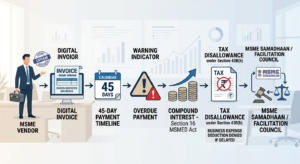
Sections 15 and 16 of the MSMED Act, 2006 require a buyer to pay a registered micro or small enterprise within the period agreed in writing, which cannot exceed forty-five (45) days from the date of acceptance of goods or services. In the absence of a written agreement, payment must be made within fifteen days. Any amount remaining unpaid beyond this period attracts compound interest with monthly rests, calculated at three times the bank rate notified by the Reserve Bank of India a rate that is deliberately punitive and cannot be waived by mutual agreement between the parties.
Aggrieved suppliers may approach the Micro and Small Enterprises Facilitation Council (MSEFC), either directly or through the online MSME Samadhaan portal, to recover both the principal and the accrued interest. Council proceedings are conducted on a summary basis, and any reference to arbitration or conciliation must first pass through the Council, limiting a buyer’s ability to rely on standard commercial arbitration clauses.
KEY COMPLIANCE ISSUES FOR BUYERS
-
Interest That Cannot Be Contracted Away
Even where a purchase order or contract specifies longer credit terms, such terms are void to the extent they conflict with the statutory forty-five-day limit. Buyers frequently assume that a negotiated ninety-day or sixty-day credit period is enforceable simply because the supplier agreed to it; in practice, the statute overrides such agreements, and interest begins accruing from day forty-six regardless of contractual terms.
-
Income Tax Disallowance Under Section 43B(h)
Since the introduction of clause (h) to Section 43B of the Income-tax Act, 1961, any sum payable to a micro or small enterprise that remains unpaid beyond the MSMED Act timeline is disallowed as a business expense in the year it is incurred, and can only be claimed as a deduction in the year it is actually paid. This converts a simple compliance lapse into an immediate tax cost, in addition to the interest liability, making delayed payments considerably more expensive than they first appear.
-
Vendor Classification and Documentation Gaps
A significant share of disputes arises because buyers fail to track which vendors are registered as MSMEs under the Udyam Registration framework, or fail to update vendor master records when a supplier’s registration status changes. Since the protections under the MSMED Act apply only to registered micro and small enterprises, accurate and current documentation is central to assessing real payment risk.
WHY THIS ISSUE MATTERS FOR BUSINESSES
This is a compliance area with consequences that extend well beyond a single overdue invoice. It demonstrates that:
- Interest under the MSMED Act compounds monthly and at a rate far above typical commercial borrowing costs, so delays that seem minor can create disproportionate liabilities,
- Disputes can be escalated directly to the Facilitation Council, bypassing internal negotiation and standard dispute-resolution clauses,
- Tax disallowance under Section 43B(h) means procurement and finance teams are now jointly responsible for payment-cycle discipline, and
- Auditors and lenders increasingly scrutinize MSME payment ageing as an indicator of financial and governance discipline.
The combined effect of statutory interest, summary enforcement, and tax disallowance means that MSME payment compliance can no longer be treated as a routine accounts-payable matter; it requires active oversight from legal and finance functions alike.
TAKEAWAYS FOR BUSINESSES
Businesses that procure goods or services from MSME vendors should:
- Identify and flag Udyam-registered vendors in procurement and accounting systems at the time of onboarding;
- Align purchase orders and contracts with the statutory forty-five-days (45) payment limit rather than standard internal credit terms;
- Track invoice ageing specifically for MSME vendors and escalate potential delays before they mature into disputes;
- Reconcile MSME payables before year-end to avoid unexpected disallowance under Section 43B(h); and
- Maintain a documented process for responding to Facilitation Council notices, since procedural defaults can quickly result in adverse awards.
As enforcement through the MSME Samadhaan portal continues to grow, buyers who treat MSME payment timelines as a compliance priority rather than a negotiable commercial term will be far better placed to avoid interest claims and reputational exposure.
CONCLUSION
MSME payment compliance sits at the intersection of contract law, tax law, and dispute resolution, and the cost of getting it wrong compounds quickly quite literally. For businesses of every size, building payment discipline into procurement and finance processes is no longer a matter of goodwill toward smaller vendors; it is a legal and financial necessity