
PRIM -The New Mutual Fund Route SEBI Just Approved
What it means for investors who have outgrown DIY but aren’t ready for PMS
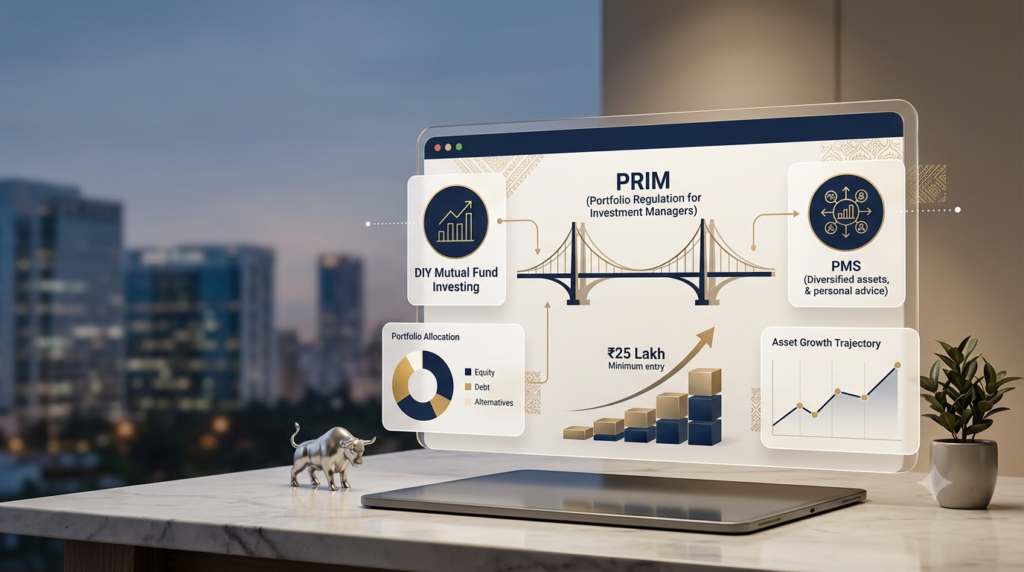
Rahul has been investing in mutual funds for eight years. He has twelve SIPs running across five different AMCs, a Nifty 50 index fund he bought on a tip, an aggressive small-cap scheme someone recommended at a dinner party, and a hybrid fund he doesn’t fully understand. His portfolio has grown, but it is also a mess -overlapping holdings, no clear logic, and no one watching the big picture. He’s heard about PMS, but the ₹50 lakh minimum is out of reach for now. If Rahul’s story sounds familiar, SEBI may have just built exactly the bridge he needed. On September 24, 2025, SEBI approved a brand-new service framework called PRIM -Portfolio Managers Route for Investing in Mutual Fund Units. It is not a fund. It is not a PMS. It is something new -a professionally managed mutual fund portfolio, accessible at ₹25 lakh, with a registered portfolio manager making the allocation decisions on your behalf.
What Exactly Is PRIM?
Think of PRIM as a middle ground between doing it yourself and handing your money to a full PMS manager. Under this framework, SEBI-registered Portfolio Managers can now build and manage curated mutual fund portfolios for clients. They do the research, pick the schemes, decide the allocation, and rebalance when needed. The client gets a consolidated, professionally managed portfolio -without having to touch a single SIP on their own. The key difference from regular mutual fund investing: you are not just picking schemes. You are hiring a professional to build a complete investment strategy using mutual funds as the building blocks. The key difference from traditional PMS: the universe is limited to mutual funds, ETFs, index funds, and Specialised Investment Funds (SIFs) -not direct stocks or complex derivatives.
Why Did SEBI Create This?
There has always been a gap in the Indian investment landscape. On one side, mutual funds: accessible, regulated, great for most investors, but fully DIY -no one is watching your overall allocation or telling you when to rebalance. On the other side, PMS: professionally managed, personalised, but entry starts at ₹50 lakh -out of reach for many serious investors. Between ₹25 lakh and ₹50 lakh, there was essentially nothing -no professional product, no managed service, no accountability for the overall portfolio construction. PRIM fills that gap deliberately. It brings professional portfolio construction to a segment of investors who had money to invest seriously but no structured service to serve them well. There is also a behavioural dimension. SEBI and market observers have noted for years that retail investors -even educated, high-income ones -tend to underperform because of emotional decisions: panic-selling in downturns, chasing last year’s top performer, never rebalancing, and accumulating funds without a strategy. A structured, manager-led approach can fix this.
What’s New Here? The Key Features
Minimum Investment- Entry at ₹25 Lakh –Significantly lower than PMS (₹50 lakh). Accessible to serious HNI investors who haven’t crossed the PMS threshold yet.
Who Manages It- SEBI-Registered Portfolio Managers –Professionals with at least ₹2 crore net worth (if operating PRIM-only) and a registered PMS licence. They are accountable, regulated, and required to disclose conflicts.
What They Can Invest In- Mutual Funds, ETFs, Index Funds, SIFs –Only direct-plan mutual fund instruments. No direct equities. No derivatives. Clean, regulated instruments -building blocks investors already understand.
Fee Structure- Management Fee Capped at 1% of AUM –Transparent, capped fee on top of the underlying fund expense ratios. Performance-linked fees are also permitted. Total cost must be disclosed upfront.
Affiliate Safeguard- Max 25% in Group / Affiliated AMC Funds –Portfolio managers cannot stack their clients’ portfolios with funds from their own affiliated AMC beyond this limit. A key conflict-of-interest control.
PRIM vs Direct MF Investing vs Traditional PMS
Head-to-Head Comparison
| Parameter | PRIM | Direct MF |
| Minimum Ticket | ₹25 lakh | No minimum |
| Who Decides Allocation | Portfolio Manager | You decide |
| Instruments Used | MF, ETF, Index, SIF | MF, ETF |
| Rebalancing | Managed professionally | Manual, your effort |
| Direct Plans | Yes (lower cost) | Yes |
| Fee | Up to 1% + fund ER | Only fund ER |
| Conflict Controls | 25% affiliate cap | No such rule |
The honest trade-off: PRIM costs more than DIY (you pay the manager’s fee on top of fund expense ratios). In return, you get discipline, professional oversight, and a coherent portfolio strategy -instead of twelve scattered SIPs with no plan.
Taxation – What Changes, What Doesn’t
This is the question every investor asks first, and the answer is reassuring. PRIM does not change the underlying tax treatment of mutual funds. The tax rules that apply to your mutual fund investments today will continue to apply -whether those funds are held directly by you or inside a PRIM portfolio.
- Equity mutual funds: Gains held beyond one year taxed at 12.5% LTCG (above ₹1.25 lakh annually). Short-term at 20%.
- Debt mutual funds: Gains taxed as per your income slab (post April 2023 rules). No indexation benefit.
- Hybrid and other funds: Taxed based on the equity/debt ratio within the fund, per SEBI classification.
- Rebalancing inside PRIM: When the portfolio manager switches between funds for you, it is treated as a redemption and reinvestment -and this triggers a capital gains tax event. Unlike a Life Cycle Fund where internal rebalancing is tax-neutral, every rebalancing move inside PRIM has a tax implication. Factor this into your cost calculation when evaluating PRIM.
Important: Unlike a Life Cycle Fund where internal rebalancing does not trigger a tax event, rebalancing within a PRIM portfolio does create a taxable event, because you are actually redeeming one fund and buying another. Factor this into your cost calculation when evaluating PRIM against alternatives.

Who Is PRIM Built For?
Four investor profiles where PRIM genuinely makes sense:
The Scattered SIP Investor –Multiple funds, no strategy, no one watching the big picture. PRIM brings structure and accountability to a portfolio that has grown without a plan.
The Serious Saver Below PMS Threshold –Has ₹25–50 lakh to invest meaningfully. Too serious for pure DIY, not yet eligible for traditional PMS. PRIM is built exactly for this person.
The Time-Starved Professional –High income, no time to research, no interest in tracking NAVs. Wants someone else to manage the allocation decisions with proper accountability.
The NRI Investor Seeking Structure –Investing in Indian markets remotely, cannot monitor daily movements. A managed mutual fund portfolio with professional oversight simplifies the process considerably.
PRIM is a regulatory framework that has been approved -the ecosystem around it is still being built.
Portfolio Managers are in the process of registering under this framework, platforms are working through operational requirements, and the full product experience for investors is yet to crystallise. What SEBI has done is lay the regulatory foundation -the structure, the rules, the safeguards. How that translates into investable products, available platforms, and competitive pricing will become clearer over the coming months. We are tracking this closely. As more details emerge -on who the registered PRIM managers will be, what their strategies look like, and how distribution will work -we will bring you a considered, updated view. For now, the framework is worth understanding. The right time to act will follow once the market matures. The goal of sound wealth management has never been to own the most products. It has been to own the right ones, in the right proportion, with someone accountable for the overall direction.