

Dear Business Owner,
If your business earns money from clients outside India, through commission, brokerage, or by arranging deals between parties, something changed on 30 March 2026 that could save you a significant amount of money every single year.
And if you pay any fees or commissions to agents or brokers based outside India, for finding buyers, sourcing suppliers, or facilitating deals on your behalf, the same change has quietly created a new tax obligation that may already be overdue.
This newsletter explains both sides in plain English. No jargon. No legal lectures. Just what happened, whether it applies to you, and exactly what you need to do next.
FIRST, THE STORY BEHIND THIS CHANGE
Imagine you are an Indian businessman. You help a German company find buyers in India. You charge them a 3% commission. You receive payment in euros. By any normal measure, you are exporting a service, just like a software company exporting code, or a factory exporting goods.
But GST law had a strange rule. It said: if you are an agent or broker, someone who arranges deals between others rather than doing the work yourself, your service is treated as if it happened in India. Even if your client is in Germany. Even if they pay you in foreign currency. Even if not a single rupee of value is consumed in India.
Result: you paid 18% GST on your commission. Your German client could not recover that GST. Your Indian competitor based in Dubai paid zero. You kept losing business, not because you were less capable, but because of a tax rule that made you 18% more expensive than your overseas counterpart.
This rule, Section 13(8)(b) of the IGST Act, was fought in courts for nearly a decade. Bombay High Court judges disagreed with each other. Gujarat High Court upheld it. Multiple businesses filed writ petitions. The GST Council recommended its removal in September 2025.
On 30 March 2026, it was finally deleted from the law.
What exactly happened on 30 March 2026?
The Finance Act 2026 received the President’s signature on 30 March 2026. Section 157 of that Act removed the rule (Section 13(8)(b)) that forced Indian agents and brokers to pay 18% GST on their foreign client earnings.
The new rule is simple: if your client is outside India, your service is treated as an export.
It happened on that date itself, you do not need to wait for a separate notification.
DOES THIS CHANGE APPLY TO YOUR BUSINESS?
Before anything else, you need to know if you are in the category of businesses this affects. The legal term is ‘intermediary’ , but in everyday language, it simply means someone who connects two other parties and earns a fee for doing so.
Here is the simplest test:
Do you earn your fee by bringing two parties together and facilitating a deal between them?
Or do you actually deliver the service yourself, directly to your client?
This change likely applies to you if…
You earn commission or brokerage fees from a foreign client for:
- Finding buyers or distributors for them in India
- Sourcing suppliers or raw materials on their behalf
- Facilitating contracts, deals, or negotiations between parties
- Acting as their agent or representative in India
- Arranging insurance, logistics, or other services on their behalf
This change probably does NOT apply to you if…
You deliver the service directly yourself, such as:
- Building software or apps for a foreign client
- Providing BPO/data processing work directly
- Running digital marketing campaigns yourself
- Providing legal, consulting, or professional advice directly
- Manufacturing and exporting goods
If you fall in the first category above, this change is directly relevant to your income and your tax bill.
If you are in the second category, your exports were already zero-rated — nothing changes for you.
Not sure which category you fall into?
The line between ‘agent/broker’ and ‘direct service provider’ is not always obvious, and your contract wording matters a great deal.
If your agreement uses words like:
- arrange
- facilitate
- procure on behalf of
- act as agent
…you are likely an intermediary.
If it says you will:
- provide
- deliver
- execute
…the service, you are probably a direct service provider.
Show your agreement to your CA or tax advisor and ask them specifically:
“Am I an intermediary under Section 2(13) of the IGST Act?”
It is a 10-minute conversation that could save you lakhs.
IF YOU ARE AN INTERMEDIARY: HERE IS WHAT CHANGED
Good news #1: You no longer pay 18% GST on your foreign earnings
From 30 March 2026, if your client is outside India and you receive payment in foreign currency, your service is treated as an export.
You raise your invoice without any GST.
Your client pays you the full commission — no tax on top.
You are now on a level playing field with your counterparts in Dubai, Singapore, and Hong Kong.
To do this, you need something called an LUT — a Letter of Undertaking.
Think of it as your annual declaration to the GST department that you will be exporting services.
It takes about 15 minutes to file online on the GST portal and costs nothing.
Your CA or accountant can do this for you today.
Good news #2: That blocked tax credit? You can now get it back.
Every year, your business pays GST on things like office rent, internet, professional fees, and software subscriptions.
This is called Input Tax Credit (ITC).
Under the old rule, because your output was taxed at 18%, you could not get a refund of this ITC — it just sat in your account, locked.
Now that your service qualifies as an export, that accumulated ITC is refundable.
Your CA can file a refund application on the GST portal.
For many businesses, this could mean getting back lakhs of rupees that have been stuck for years.
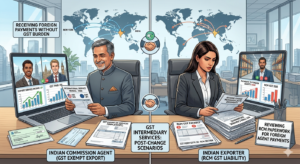
One important condition you must check
For your service to be treated as an export, your payment must come in foreign currency — typically US dollars, euros, pounds, or another convertible currency.
If your foreign client is paying you in Indian rupees (without a specific RBI permission), the export treatment may not apply.
Check your payment terms and the currency in which you actually receive money.
What about the GST you have been paying all these years?
The law change is effective from 30 March 2026 onwards.
It does not cancel or refund the GST you paid in previous years automatically.
However, if you have pending legal disputes, show-cause notices, or appeals related to GST on your intermediary services for past years, speak to your advisor immediately — the deletion of this rule significantly strengthens your position in those disputes.
THE OTHER SIDE OF THE COIN: PAYING FOREIGN AGENTS
Now here is the part that most businesses have not heard about yet — and it is urgent.
If you pay commissions, brokerage, or agent fees to someone based outside India — a foreign agent who finds buyers for your products abroad, a procurement agent who sources parts for you from global markets, a marketing representative who opens doors for your business in the US or Europe — this change affects you too.
But in a different way.
Until 30 March 2026, when you paid such a foreign agent, there was no GST involved.
The rule said the tax happened at the foreign agent’s location — outside India.
So India had no claim on it.
From 30 March 2026, the same rule that helps Indian exporters has quietly flipped the position for importers.
The tax now happens at your location — in India.
You are the one who must pay the GST, even though the invoice came from outside India.
This is called Reverse Charge Mechanism, or RCM.
If you pay any fees to a foreign agent or broker, you may already owe GST.
This obligation started on 30 March 2026.
If you paid any commission, finder’s fee, or brokerage to a foreign agent in April or May 2026 and have not paid GST on it, you are already behind.
Interest starts running from the date the payment was due.
The longer you wait, the more it compounds.
What is RCM and how does it work?
RCM sounds complicated but the concept is simple.
When you buy a service from someone outside India and there is Indian GST to be paid, the law says you — the buyer in India, pay the GST yourself.
You do not wait for the foreign agent to pay it.
You self-assess, self-pay, and self-declare it.
Here is the practical flow:
- Your foreign agent sends you a commission invoice for, say, ₹2 lakhs.
- You calculate 18% GST on that: ₹36,000.
- You raise what is called a ‘self-invoice’ , basically an invoice that you issue to yourself to document this transaction.
- You pay the ₹36,000 GST from your GST cash account, not from your regular ITC balance.
- You declare it in your monthly GST return (GSTR-3B).
- In the same return, you claim the ₹36,000 back as a credit, which reduces your GST payable that month.
Is this actually costing me money?
For most businesses: no, not really, but there is a timing issue.
You pay ₹36,000 from cash first.
Then you claim it back in the same return.
So by the end of the month, it nets to zero.
But you do need that cash available on the day you file your return.
However, if your business has a lot of tax-exempt income, like exports of goods, you may not be able to claim the full credit back.
Your accountant will know your specific situation.
Ask them.
REAL EXAMPLES FROM REAL BUSINESSES
CASE STUDY 1: The Commission Agent Who Just Got a Pay Rise
Ramesh runs a trading company in Ahmedabad.
He earns commission from a German machinery company for finding Indian buyers.
Each month, his commission is around ₹4 lakhs.
Under the old rule, he was paying ₹72,000 in GST — 18% of his earnings.
He never saw that money.
The German company could not recover it.
It was simply lost.
Before 30 March 2026:
Ramesh pays ₹72,000 every month in GST. That is ₹8.6 lakhs a year. Gone.
From 30 March 2026:
Ramesh’s German client pays him ₹4 lakhs. Zero GST. Ramesh keeps the full amount.
He files an LUT once a year.
He also files a refund claim for the tax credit that was building up on his office and phone bills.
The German client is happy. The deal continues.
Watch out for:
The LUT must be filed before he raises his first zero-rated invoice.
Any invoice he raised at 18% after 30 March 2026 needs to be revised with a credit note.
Your next step:
Ramesh’s accountant should file the LUT immediately, then file a refund claim for accumulated credits.
Total time: one working day.
CASE STUDY 2: The Exporter Who Now Has a Surprise GST Bill
Sunita runs a garment export business in Tirupur.
She uses an agent based in the UK who finds buyers for her in Europe.
She pays him a 2% commission on every shipment.
On a ₹50 lakh shipment, that is ₹1 lakh going to the UK agent.
Before 30 March 2026:
Sunita pays ₹1 lakh to the UK agent. No GST involved anywhere in India.
No paperwork related to GST for this payment.
From 30 March 2026:
Sunita still pays ₹1 lakh to the UK agent.
But now she must also pay 18% GST (₹18,000) on top of this — through the Reverse Charge mechanism.
She pays this from her GST account, claims it back in the same month’s return, and the net impact on her wallet is zero.
But she must do the paperwork.
Watch out for:
Sunita may have already missed April 2026.
Interest is running.
The longer she waits, the more complicated this gets.
Your next step:
Ask your accountant to check every payment you made to foreign agents since 30 March 2026.
For each one, they need to create a self-invoice and pay GST.
If you missed it, they should file a voluntary correction (DRC-03) to reduce the penalty.
CASE STUDY 3: The IT Company That Does Not Need to Worry
Priya runs a software development company in Hyderabad.
She has a long-term contract with a US company to build and maintain their internal tools.
She provides the service herself, directly.
Before 30 March 2026:
Priya was already exporting services.
She paid zero GST on her US client invoices.
She was always zero-rated because she is a direct service provider, not an agent.
From 30 March 2026:
Nothing changes for Priya.
She was never an intermediary.
The deleted rule never applied to her.
Her exports continue exactly as before.
Watch out for:
Some software companies are confused and think this change affects them.
It does not, if you do the work yourself and deliver it directly to your client.
Your next step:
No action needed.
But if the department ever raised a notice calling your services ‘intermediary’, speak to your advisor.
This amendment further supports your position.
WHAT YOU NEED TO DO RIGHT NOW
If you earn commission or fees from foreign clients:
- Talk to your accountant today — Show them this newsletter and ask: am I an intermediary? If yes, what do I need to do?
- File an LUT on the GST portal — This is a one-time annual filing that lets you raise invoices without charging GST.
- Check your recent invoices — Any invoice raised with 18% GST after 30 March 2026 needs to be corrected with a credit note to your foreign client.
- Ask about your refund — Your accountant can file a claim to recover the tax credits that have been building up on your business expenses.
- Check how your client pays you — Payment should be in foreign currency. If it is in Indian rupees, discuss with your advisor whether zero-rating still applies.
If you pay commissions or fees to foreign agents:
- Ask your accountant to review all foreign agent payments from 30 March 2026 — Any payment to a foreign agent, broker, or facilitator may now attract GST.
- Do not delay — interest is already running.
- Ask them to raise self-invoices for past payments — This is the paperwork that formalises the transaction for GST purposes.
- Make sure the GST amount is included in your next monthly return — Your accountant will know which table in GSTR-3B to use.
- Claim the credit back in the same return — If your business makes taxable sales, you can claim this GST back immediately.
A Word From Our Desk
Every few years, a tax change comes along that genuinely matters to business owners — not just in a technical sense, but in a real, financial sense that you feel in your bank account.
This is one of those changes.
For businesses earning commission from foreign clients, this is the equivalent of an 18% pay increase on those earnings.
Not because you negotiated harder.
Not because you found new clients.
Simply because a rule that was penalising you has been removed.
But we have seen this pattern before.
Businesses that act fast — who file the LUT this week, who correct their old invoices, who put in the refund claim — they capture the benefit from day one.
Businesses that wait for “someone to tell them” often discover six months later that they have been leaving money on the table.
On the other side, we have already seen businesses that pay foreign agents continuing as if nothing changed.
That is a mistake.
The GST obligation is real, it started on 30 March, and interest is compounding silently every day.
The ask is simple:
Forward this newsletter to your accountant.
Read it together.
Spend 20 minutes.
It could be the most valuable 20 minutes of this quarter.