
ROC ADJUDICATION ORDER
Conversion into Public Company with Only Three Members
Adjudicating Authority: ROC Delhi-II (Order ID: PO/ADJ/10-2026/DC/03010, dated 12/10/2026).
Company: Trontek Electronics Limited (CIN: U27101DL2006PLC154820).
Provisions Violated: Section 3(1)(a) read with Section 18 of the Companies Act, 2013.
Penal Section: Section 450 of the Companies Act, 2013.
1. Background of the Case
The Registrar of Companies, Delhi-II, passed an adjudication order dated 12 October 2026 in the matter of Trontek Electronics Limited for violation of Section 3(1)(a) of the Companies Act, 2013.
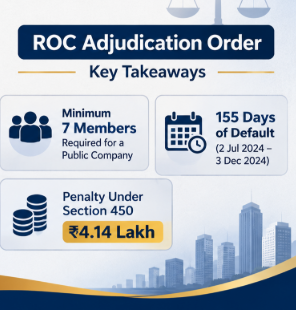
The company was converted from a Private Limited Company into a Public Limited Company on 2 July 2024. However, at the time of conversion, the company had only three members, whereas Section 3(1)(a) of the Companies Act, 2013 mandates a minimum of seven members for a public company.
The company subsequently rectified the non-compliance on 3 December 2024 by transferring 40 equity shares to four individuals, thereby increasing its membership from three to seven.
2. Section 450 – Punishment where no specific penalty or punishment is provided
Where a company or any officer of a company or any other person contravenes any provision of the Act or the rules made thereunder, and no specific penalty or punishment is provided elsewhere, the contravention attracts:
| Initial penalty | Rs. 10,000 |
| Additional penalty | ₹1,000 for every day during which the contravention continues |
| Maximum penalty | ₹2,00,000(company) |
| Maximum penalty | ₹50,000 for an officer in default or any other person. |
3. Observations of the ROC
The ROC observed the following:
1. The company filed a Suo-moto application in Form GNL-1, admitting non-compliance with Section 3(1)(a) read with Section 18 of the Companies Act. A public company is required to maintain a minimum of seven members under Section 3(1)(a) of the Companies Act, 2013.
2. The company continued to have only three members from 2 July 2024 to 3 December 2024, resulting in a default period of 155 days.
3. Subsequent rectification of the default by increasing the number of members to seven did not absolve the company of liability for the earlier period of non-compliance.
4.. The CFO, Company Secretary although appointed after the commencement of the default were also held liable as officers in default for the relevant period of their association with the company.
5. No penalty was imposed on the two independent/non-executive directors specifically exempted in the order.
4. Penalty Imposed
The ROC imposed the following penalties under Section 450 of the Companies Act, 2013:
| Particulars | Penalty |
| Trontek Electronics Limited | ₹1,64,000 |
| CFO | ₹50,000 |
| Company Secretary | ₹50,000 |
| Three other directors (₹50,000 each) | ₹1,50,000 |
| Two exempted directors (NON-EXECUTIVE AND INDEPENDENT) | NIL |
| Total Penalty | ₹4,14,000 |
5.Conclusion & Secretarial Takeaway
Strict Inapplicability of Section 3A to Initial Shortfalls
The ruling firmly establishes that the six-month statutory grace period under Section 3A of the Companies Act, 2013, is an operational defense available only when a company initially satisfies the prescribed minimum membership (seven members for a public company) and subsequently suffers a reduction. Section 3A cannot be retrospectively invoked to cure a structural deficiency that existed right on the effective date of conversion under Section 18 read with Section 3(1)(a).
Even though the Company Secretary and Chief Financial Officer were appointed subsequent to the conversion date, ROC Delhi-II held them liable as “officers in default” under Section 450 because they failed to independently audit, identify, and regularize the ongoing non-compliance upon assuming office.