
Everyone remembers their first investment. The excitement. The hope. The slightly nervous feeling as you tap confirm on the app.
And then sometimes the regret. The panic when the market dips. The frustration when a sure thing tip goes nowhere. The confusion about why, despite doing something, your money doesn’t seem to be going anywhere meaningful.
Here’s the honest truth: almost every first-time investor makes mistakes. Not because they are foolish but because nobody taught them the rules of the game before they started playing. And most people don’t have access to proper wealth management services or an investment advisor to guide them from the beginning. So, they learn by trial and error which can be expensive.
This article is about those mistakes. The common ones. The costly ones. And most importantly the completely avoidable ones.
Read this before you invest another rupee.
Part 1: The Mistakes Most Beginners Make
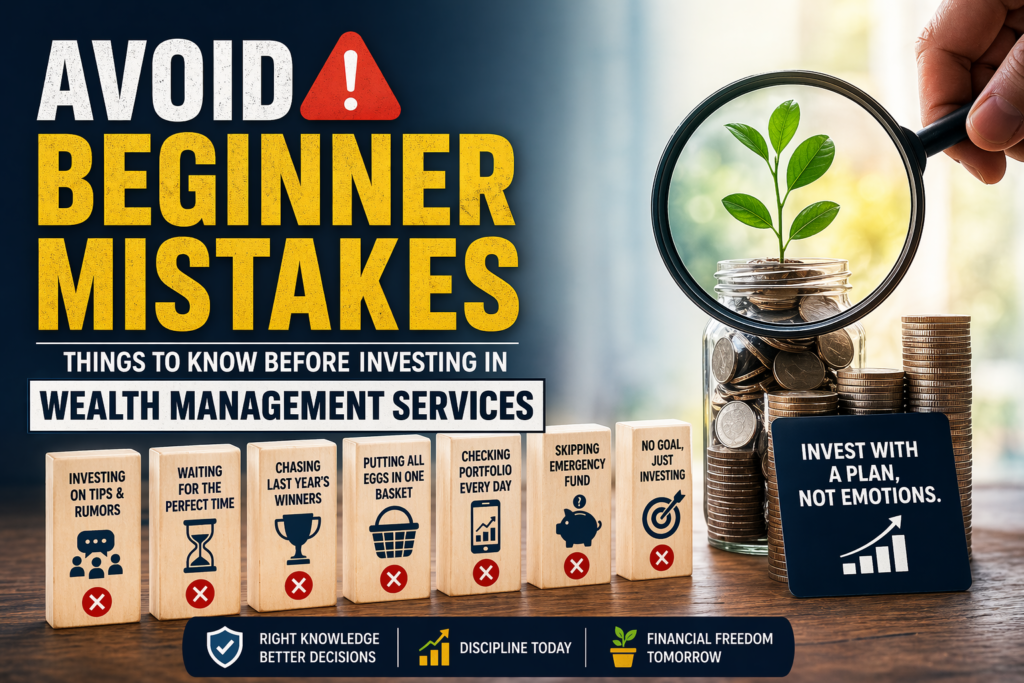
Mistake 1: Investing Based on Tips and Rumours
Your colleague made 40% returns on a stock. Your uncle swears by a particular small-cap company. A WhatsApp forward promises a multi-bagger that will double in six months. So you invest without understanding what the company does, how it earns money, or why the price might actually go up.
Why it happens: We are wired to trust people we know. When someone we respect makes money, we want in. Fear of missing out (FOMO) is one of the most powerful emotional forces in investing.
What to do instead: Before investing in anything, ask: Do I understand this? Can I explain why this is a good investment in two sentences? If the answer is no- Then Wait!! A qualified investment advisor can help you evaluate opportunities with logic instead of emotion.
Mistake 2: Waiting for the Perfect Time to Invest
The market seems high so you wait. Then it dips and you panic and wait some more. Months pass. Sometimes years. And the money that could have been compounding quietly in a mutual fund just sits in a savings account earning 3.5%.
Why it happens: Our brains hate uncertainty. We are always looking for signals that it is safe to act. But in investing, waiting for certainty means waiting forever because certainty never fully arrives.
What to do instead: Time in the market beats timing the market. Start with whatever you can afford today. A SIP of even Rs. 1,000 a month, started now, is worth far more than Rs. 10,000 invested at the perfect moment three years from now.
Mistake 3: Chasing Last Year’s Winners
The fund that gave 60% returns last year looks irresistible. So, you put most of your money there only to watch it underperform significantly in the next 12 months. This is one of the most common and painful beginner mistakes.
Why it happens: Past performance feels like evidence of future results. It is not. Markets cycle occurs. What worked last year often does not work next year. Chasing returns is how investors buy high and sell low the exact opposite of what they intend.
What to do instead: Choose investments based on your goals and time horizon not on last year’s returns chart. A diversified portfolio built around your personal plan will almost always outperform chasing trends over the long run.
Mistake 4: Putting All Eggs in One Basket
You believe deeply in one stock, one sector, or one asset class. So you go all in. Sometimes it works brilliantly and you feel like a genius. More often, it exposes you to risk that could have easily been avoided.
Why it happens: Overconfidence. When we believe in something strongly, we underestimate how wrong we can be. Conviction is good. Concentration without a safety net is dangerous.
What to do instead: Diversify across asset classes (equity, debt, gold), across sectors, and across geographies if possible. This is something good wealth management services always prioritise. Diversification does not eliminate risk, but it ensures that one bad bet does not define your entire financial future.
Mistake 5: Checking Your Portfolio Every Single Day
You refresh the app every morning. Every green number feels like validation. Every red number feels like a crisis. You start making decisions based on daily movement selling when things dip, buying when things spike. The result? You buy high, sell low, and pay transaction costs along the way.
Why it happens: We are emotional creatures. Loss feels roughly twice as painful as equivalent gain feels good this is called loss aversion, and it is hardwired into human psychology. Daily portfolio checking feeds this cycle.
What to do instead: Set a schedule. Review your portfolio once a month maximum once a week. Check that your investments are aligned with your plan. Then close the app and live your life.
Mistake 6: Skipping the Emergency Fund
You are excited to invest so you put everything you can into the market. Then life happens. A medical bill. A job transitions. A home repairs. Suddenly you are forced to sell your investments at the worst possible time often during a market dip just to cover immediate expenses.
Why it happens: Optimism bias. We tend to underestimate the likelihood of unexpected events happening to us personally. So, we skip the safety net and go straight to growth mode.
What to do instead: Before investing a single rupee in the market, build an emergency fund of 3 to 6 months of your expenses in a liquid, accessible account. This is not optional. It is the foundation everything else rests on.
Mistake 7: Not Having a Goal Just Investing
You invest because you know you should. But you have no specific goal, no time frame, and no idea how achievement is meant . So, when the market drops 15%, you panic because you have no anchor telling you why you are in this for the long run.
Why it happens: Vague intention leads to emotional decision-making. Without a goal, every market movement feels personally relevant. You react instead of staying the course.
What to do instead: Write down your goals before you invest. Not ‘I want to grow my money’ but ‘I want Rs. 50 lakhs in 10 years for my child’s education’ or ‘I want to retire at 55 with a comfortable corpus.’ Specific goals are also the starting point of solid retirement planning and they give you a reason to stay invested through short-term turbulence.
Part 2: The Real Enemy Your Own Emotions
If you notice a pattern in the mistakes above, it is this: almost none of them are about the wrong fund or the wrong stock. They are about emotion overriding logic at the worst possible moment.
This is not a personal failing. It is human nature. Our brains evolved to respond to immediate threats and rewards not to think calmly about 20-year investment horizons. This is also why even experienced investors benefit from working with an investment advisor someone who brings calm, objective thinking when emotions run high.
The 4 Emotions That Most Often Derail Investors
- Fear
Fear peaks when markets fall. It whispers: Get out now before you lose everything. It is the emotion behind panic selling exiting investments at exactly the moment you should be holding (or even buying more). Fear protects us from physical danger, but in investing, it almost always costs money.
- Greed
Greed peaks when markets rise. It whispers: Hold on it will go higher. It is the emotion behind holding too long, taking excessive risk, and ignoring valuation. The same people who panic-sell during crashes often refuse to book profits during rallies because greed has taken over from judgment.
- FOMO Fear of Missing Out
FOMO is what makes you invest in something you do not understand because everyone else seems to be making money from it. It drove millions of people into crypto at peak prices. It drives people into hot IPOs without reading the prospectus. It is one of the most expensive emotions in investing.
- Overconfidence
A few good early returns can convince a beginner that they have a special talent for picking stocks. This leads to larger bets, less diversification, and less caution right before the market reminds them that luck and skill are very different things.
The stock market is a device for transferring money from the impatient to the patient. Warren Buffet
Part 3: How to Keep Emotions Out of Your Investment Decisions
Knowing your emotional triggers is only half the battle. Here is how to actually build guard rails around them:
- Write your investment plan down and read it when markets panic. A written plan is the antidote to in-the-moment emotion.
- Automate your investments. A SIP invested automatically on the 1st of every month removes the temptation to time the market or skip months when you feel uncertain.
- Define what success looks like before you invest not after. This is especially important for long-term goals like retirement planning, where the destination needs to be clear before the journey begins.
- Work with a qualified investment advisor who will tell you the truth and not what you want to hear. Good wealth management services include this as a core offering: someone in your corner who keeps you grounded when the market gets noisy.
- Expect volatility and accept it as the price of long-term returns. A market that goes up every day is not a market. Some turbulence is not a crisis. It is normal.
- Give yourself a 48-hour rule. Before making any investment, decision driven by news or market movement, wait 48 hours. If it still seems like the right decision then act. If not, you just saved yourself from an emotional trade.
A Final, Honest Word
Nobody invests perfectly. Not in the beginning. Not ever, really.
The investors who build real wealth over time are not the ones who never made mistakes. They are the ones who made mistakes early, learned from them, and then built a system often with the help of good wealth management services that protected them from repeating those mistakes over and over.
You are ahead of most people simply by reading this. You now know what to watch for from missing an emergency fund, to ignoring retirement planning, to letting fear make decisions that logic should be making. The market is not your biggest risk. Your own emotional reactions to the market are.
Invest with a plan. Invest with patience. And when fear or greed comes knocking and they will take a breath, read your goals, and remember why you started.
Investing is not about beating others at their game. It is about controlling yourself at your own game.
The best investor you can be is a calm, consistent, and self-aware one.
Start there. Everything else follows.
Wealth Management Services: FAQs for Beginner Investors
What are the most common beginner investing mistakes?
Most beginners rely on tips, try to time the market, and invest without clear goals or diversification. These mistakes often lead to emotional decisions and inconsistent returns.
Do I need wealth management services as a beginner?
Yes, wealth management services help you build a structured investment plan and avoid costly mistakes. They provide guidance, diversification, and long-term strategy.
How can an investment advisor help new investors?
An investment advisor brings objectivity and expertise, helping you make informed decisions instead of emotional ones. They align your investments with your financial goals.
Why is an emergency fund important before investing?
An emergency fund prevents you from selling investments during market downturns for urgent needs. It acts as a financial safety net and protects your long-term plan.
How often should I check my investment portfolio?
Checking your portfolio too often leads to emotional decisions and unnecessary actions. Reviewing it monthly or quarterly is usually sufficient for long-term investors.